Hidden Expectations & Hidden Barriers: The Rules No One Tells You & The Challenges No One Sees.
Estimated Reading Time: 3-4 minutes
Despite the very best intentions, sometimes it can seem impossible to make inclusion work.
Even when you genuinely welcome neurodivergent children to your classroom or program, or when you write inclusive policies and adopt inclusive practices, the inclusion doesn’t quite stick. The child still struggles to participate and never really feels like they belong.
This is the reality for many neurodivergent kids (and adults), and the reason this problem is so hard to solve is because it’s largely invisible. And the hardest part is that there’s invisibility on both sides.
I call them Hidden Expectations and Hidden Barriers.
I developed these two concepts as part of the EPIC Participation Framework™ to give language to the things I had felt, seen and heard about over the years. The Hidden Expectations and Hidden Barriers work together to make participation harder than it needs to be, even when everyone is acting with the best intentions.
Hidden Expectations are invisible to the child or participant, and include the rules they are expected to know but were never told. Think of social norms, but also environmental expectations, like where to sit, when to speak and what to do.
Hidden Barriers are invisible to the educator, instructor or program facilitator, and include things about the environment that create extra effort without anyone realising, such as sensory challenges, rigid behavioural expectations or the pressures of masking.
Generally, both are doing their best they can with only half the information.
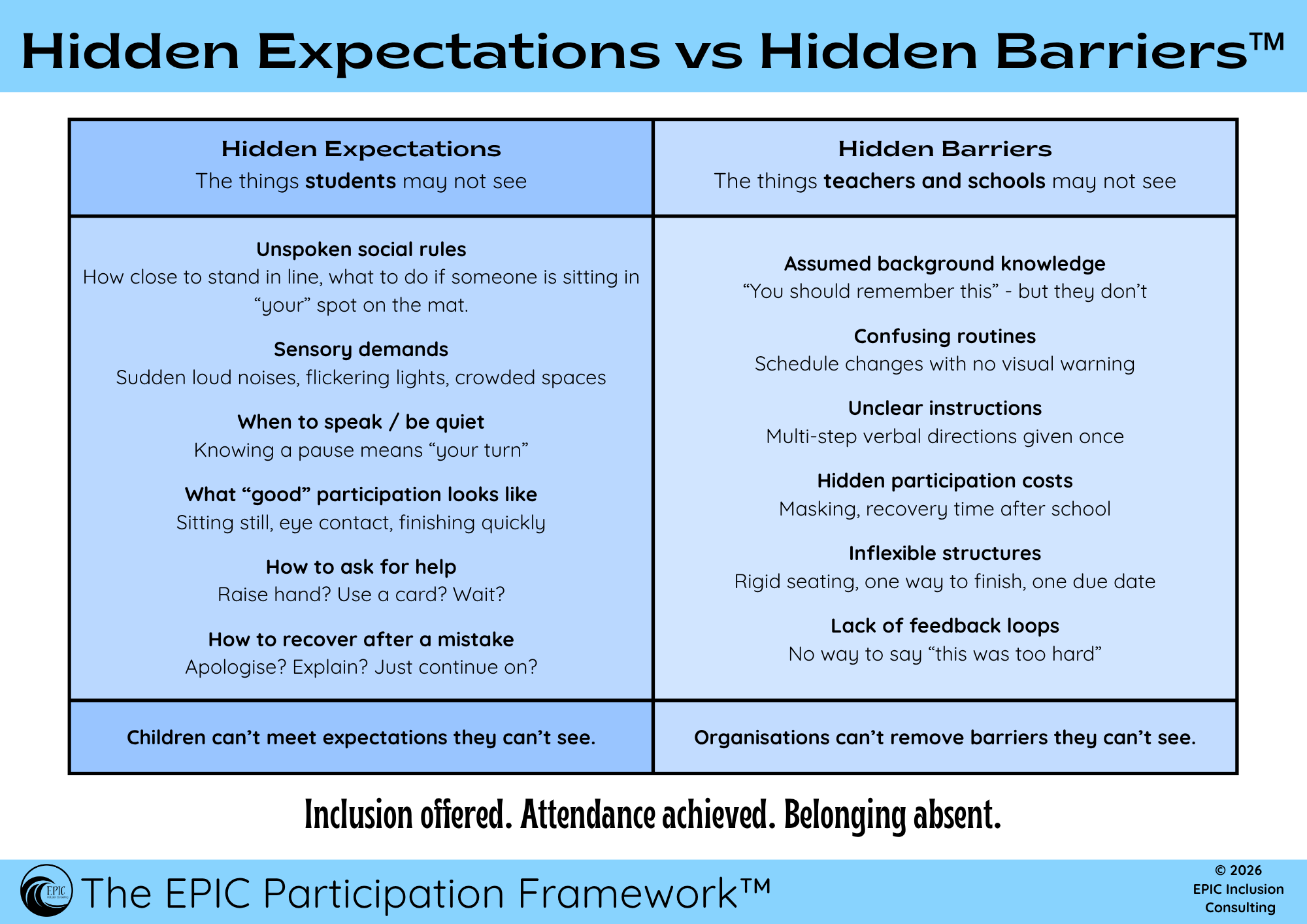
Hidden Expectations vs Hidden Barriers
What does this look like in real life?
Hidden Expectations: the child's side of the invisibility.
A teacher says "line up." But no one explained where the line starts, which order to stand in, or what to do while waiting. A child stands in the wrong spot. They don’t stand still, and they look like they're not listening. But they weren’t explicitly taught these things, they’re just expected to know or pick it up by watching those around them.
This can happen anywhere: the classroom, the sporting field, the hall, the music studio. Anywhere where adults assume that children already know the routine.
Other examples:
"Wait your turn" - but how does the child know when it's their turn?
“Line up” - but what should the child d
"Be respectful" - but what does that look like here?
"Ask for help" - but what's the right way to ask?
“Remember your equipment” - but no support is offered.
Hidden Barriers: the organisation's side of the invisibility.
A community program takes place in a noisy hall that the facilitators have learned to ignore. But a new child finds it overwhelming. Facilitators don't notice because it isn’t overwhelming to them, it’s invisible.
Other examples:
Bright lights or strong smells: staff barely notice it, but neurodivergent children do.
Tactile sensitivities: the expectation to wear a certain uniform or engage in a messy activity that doesn’t bother others.
Confusing, unpredictable or unclear routines: can overload cognitive and emotional capacity
Sudden schedule changes or transitions without warning or support: can cause distress.
Instructions only given once, or given too quickly: can cause confusion or distress when children don’t know what to do
These all contribute to the Participation Tax: the sensory, cognitive, social, emotional, transition and recovery effort required to participate in any environment. I’ve discussed this at length in previous posts, if you’d like to know more.
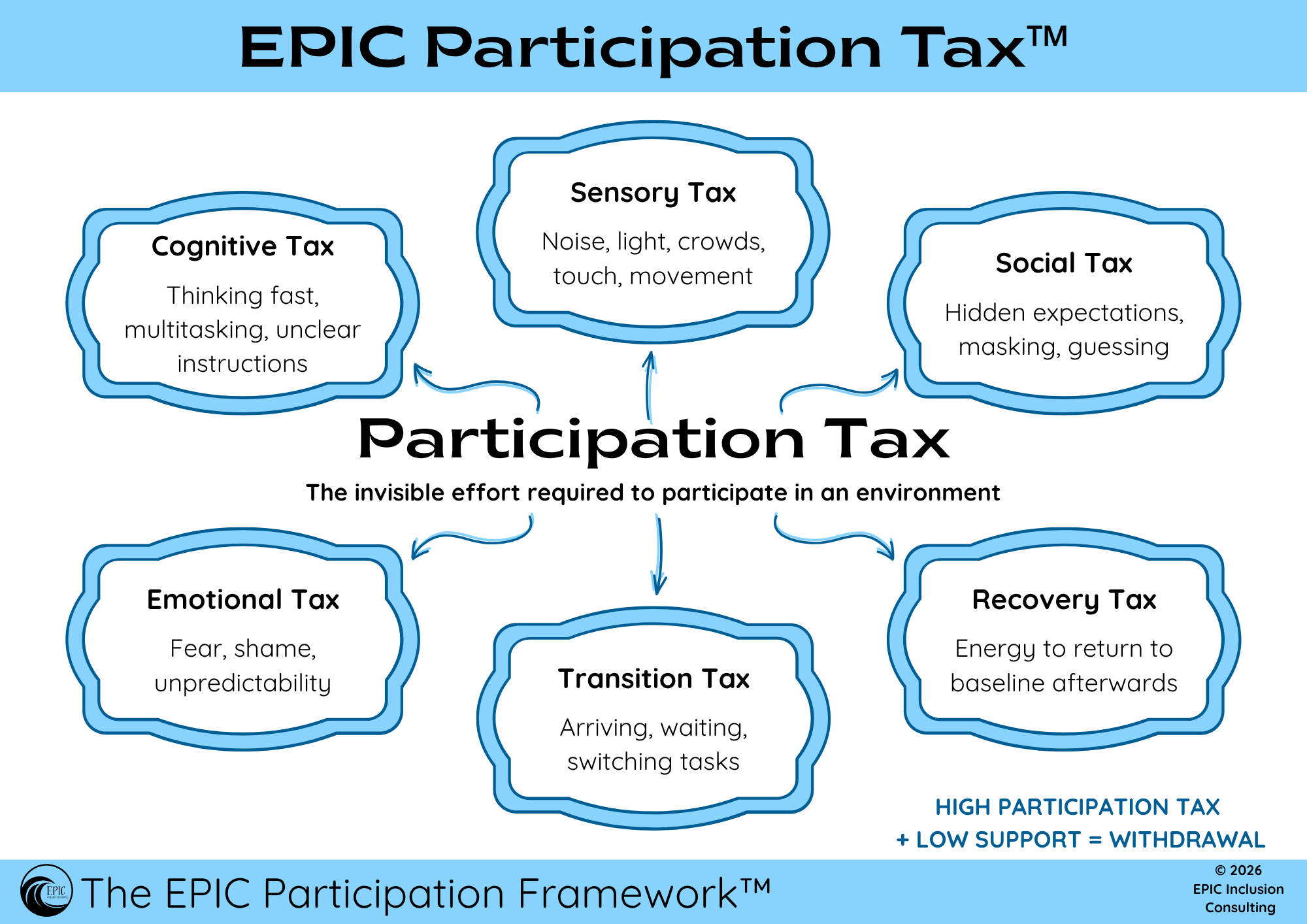
The 6 Types of Participation Tax
Small adjustments that work in any setting
You can't fix what you can't see. So, you can start by looking closely at your environment.
Walk through your setting as a new neurodivergent child or participant. What might confuse them? What might they not know? Write it down. Bring in a fresh set of eyes - ask a colleague from another program or class to observe.
Ask families what felt hard. Rather than asking "did you have a good time?", ask "what was confusing or tiring?" Listen without getting defensive.
Make one hidden expectation visible this week. Add one sign, explain one rule out loud, or use one visual card. Small changes make a big difference.
Check your hidden barriers. Is your space predictable? Do you warn before transitions? How would you describe the lighting, or the volume? If you've stopped noticing something, it might be a barrier.
For parents reading this
You've probably seen both sides of this. Your might notice your neurodivergent child struggles to follow rules when they’re not explicitly laid out, step by step. Or you might notice that a program or facilitator doesn’t really understand how to make inclusion work for your child.
Ask programs, facilitators or educators specific questions. "What are the unspoken rules here?" "How do children know when it's their turn?" “What do they do while waiting?” "What happens if my child needs a help or a break?"
You don't have to explain everything. A diagnosis isn’t necessary if you don’t feel comfortable disclosing. A simple "my child needs clear, visual instructions" can be enough to communicate support needs. It’s the environment’s responsibility to adapt, not your child’s.
You don't have to guess
The EPIC Participation Framework™ helps organisations and families see what's invisible. If you're ready to look at your program or classroom through fresh eyes, or you're tired of your child being misunderstood, I’d love to chat.
One last thought
Hidden Expectations and Hidden Barriers aren't anyone's fault. But once you see them, you can change, reduce or support them. And when you do, children stop putting all their effort into participating, and start belonging.
Visit these pages for more information:
Blog Post: That Hidden Cost of Joining In (And Why Some Kids Pay More)
Blog Post: The Participation Pathway: Why Some Children Check Out Before Participation Begins