The Hidden Cost of Teaching (Even When You're Brilliant at It)
Estimated Reading Time: 3-4 minutes
My passion and skills as a teacher make me a valuable asset to any school, but they also come at a pretty high cost.
I adore teaching... education is a special interest of mine! Because as a teacher with late-diagnosed autism and ADHD, the same complex, wonderful brain that makes me exhausted and dysregulated also makes me exceptional in the classroom.
I often talk about how the Participation Tax affects neurodivergent children. But it doesn’t necessarily get easier as we get older - especially for those of us who were late-diagnosed and are still learning strategies that work safely for us.
As neurodivergent educators, we often pay a huge personal cost to show up at work each day. In some cases, we are supported by a workplace that actively works towards reducing this cost where possible. In other cases, an unsupportive workplace raises this cost significantly. For educators experiencing autistic burnout, even the most supportive workplace can cost more than we can afford.
This post explains what the Participation Tax can look like, what can help, and why neurodivergent teachers deserve better support.
What makes me (and many neurodivergent educators) incredible in the classroom
Many of my AuDHD traits aren't weaknesses. In fact, they’re often the reason students feel connected to and safe with me and other neurodivergent educators. These traits can include:
Deep empathy: I notice the anxious, overwhelmed, or excluded child because I've lived it.
Exceptional inclusion mindset: I ask questions like "how can we make this work for this child?" instead of "how can we make them fit?"
Systems thinking: I see how behaviour, environment, sensory factors and relationships all connect and influence each other.
Pattern recognition: I spot trends and barriers that others miss.
Strong sense of fairness: Students trust me to advocate for equitable treatment. In my classroom, students receive what they need in the moment, regardless of diagnosis.
High preparation skills: I plan thoroughly, creating calm and structure.
Creativity and flexibility: I think outside the box for adjustments and lessons, creating an environment that balances novelty and predictability.
Authenticity: Children are drawn to genuine teachers, particularly those who are “like them”.
Clear explanations: My need for clarity means I reduce ambiguity for students.
Persistence: I don't give up on struggling students.
These strengths don’t exist despite my neurotype. They exist because of it.
The Participation Tax of casual teaching (even at a familiar school)
Some people think casual teaching is "easier" - no planning, no reports, no parent meetings. And in some ways, that can be true. But for many neurodivergent nervous systems, it can actually be a lot harder.
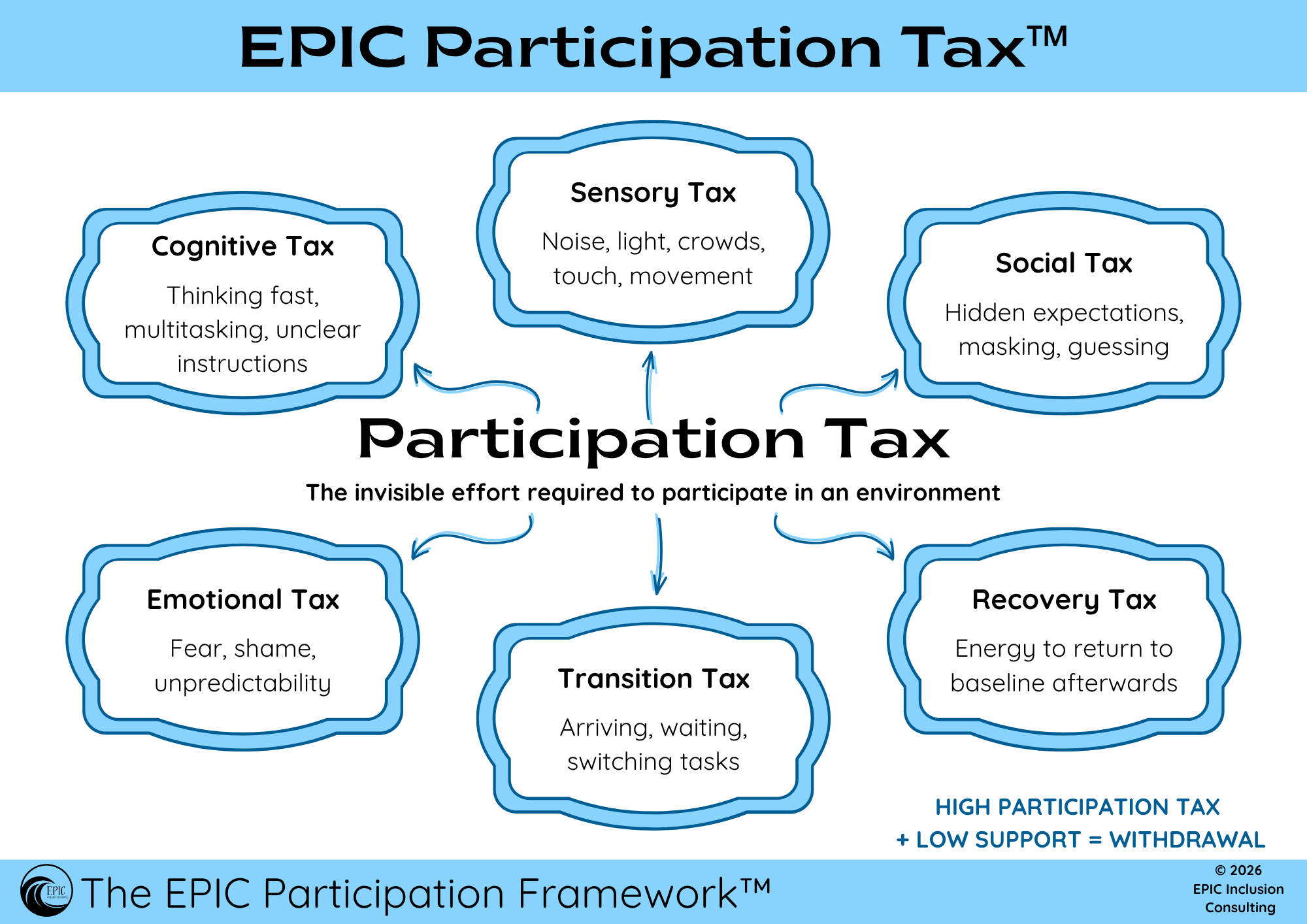
The 6 Participation Tax types
I work at only one school, where I know the staff, students, school layout and general routine. But even so, I pay a huge cost every workday:
Sensory tax: constant noise, bells, movement, crowded corridors, with almost no chance to regulate.
Cognitive tax: the uncertainty of not knowing which classroom I’ll be in, or if I’ll even be working. Last minute lesson plans with no prep time.
Emotional tax: unresolved feelings about not securing a contract, professional identity shifts, feeling like I’m not fully understood and not feeling like I belong.
Social tax: smalltalk and staffroom interactions can drain my energy.
Transition tax: waking, leaving home, entering work mode, moving between classes, and returning home… each shift forces my nervous system to adapt.
Recovery tax: the school day ends, but my brain keeps processing, replaying, decompressing for hours.
If I were casual at multiple schools, the tax would be even higher: new environments, new staff, new routines, new Hidden Expectations and Hidden Barriers every single day. Many casual teachers do that. I honestly don't know how they survive.
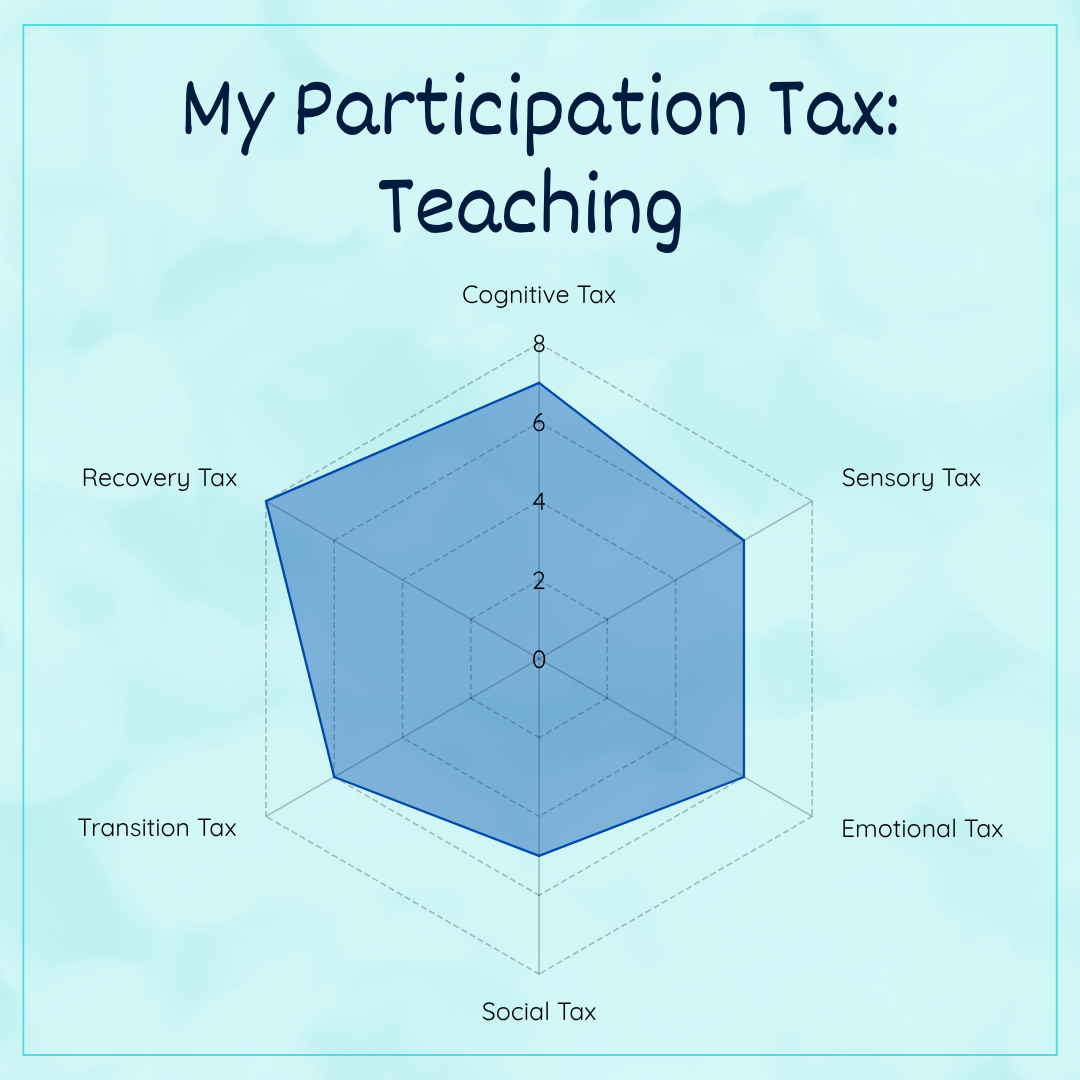
My Personal Participation Tax Matrix for Teaching
Even permanent and contract teaching carries a Participation Tax
Let me be clear. Teaching as a permanent or on a contract is far from tax‑free. I found that having structure and predictability lowered some participation costs, but others remained. These include:
Emotional load of caring for 20-30 children daily.
Cognitive load of planning, assessing, and differentiating.
Sensory load of the school environment.
Administrative and compliance demands.
Responsibility for student outcomes.
Teaching is a high‑tax profession for everyone. But for neurodivergent teachers, the cost is often much higher, rises much faster, and the effects last much longer.
How to support a neurodivergent teacher (so they can be their best)
If you lead a school or work alongside neurodivergent colleagues, small changes make a huge difference.
Reduce uncertainty where possible. Share lesson plans in advance. Provide clear agendas for meetings. Avoid last‑minute changes without explanation, and allow time to process changes.
Protect preparation time. For many of us, planning isn't just professional practice - it's an accommodation that lowers cognitive tax. Being familiar with the content
Offer a low‑sensory space. A quiet corner or office to retreat to during breaks can make a big difference.
Allow flexible regulation. Stepping outside with the class for fresh air, using noise‑cancelling headphones during non‑instructional time, using fidget tools during meetings. These aren’t unprofessional, they help neurodivergent educators regulate and can increase their performance.
Recognise that recovery is part of the work. Don't schedule back‑to‑back demanding tasks. Building in regulation buffers can help lower rising taxes.
Ask, don't assume. "What would make your day more sustainable?" is a powerful question and shows a genuine desire to support.
Stop expecting neurodivergent teachers to mask. Authenticity is a strength. Support them to exist and work in ways that work for their brain.
Why this matters - and what you can do
Neurodivergent adults have many of the same challenges as neurodivergent children. We still experience sensory overload, struggle with Hidden Expectations, and are overwhelmed by high Participation Taxes. We just mask it better than kids do - until we burn out.
I've been developing the EPIC Participation Framework to help schools and community organisations understand these hidden costs, for neurodivergent people and for the people who support them.
Later this year, I'm launching professional learning for teachers and schools. This will help you recognise the Participation Tax in your own workplace, design more sustainable environments for neurodivergent students, and help you support passionate neurodivergent educators to stay in the classroom where we belong.
If you'd like to know when training is available, follow me for updates!
And for the amazing neurodivergent educators reading this, please know that you’re not failing. Teaching is SO rewarding, but the Participation Tax is undeniably high. Your neurodivergent students deserve to be supported, and so do you.
Visit these pages for more information:
Blog Post: The Regulation Wave: A Reasonable Neurodivergent Crash Out.
Blog Post: Hidden Expectations & Hidden Barriers: The Rules No One Tells You & The Challenges No One Sees.
Blog Post: That Hidden Cost of Joining In (And Why Some Kids Pay More)