Co-Regulation: Sharing the Work of Calming Down
Estimated Reading Time: 4-5 minutes
Telling someone to “calm down” rarely works. In fact, it often has the opposite effect.
As humans, it’s not always easy for us to calm down. But for neurodivergent children and adults, regulating our emotions and our nervous system can be incredibly challenging.
The thing is, self‑regulation isn't something we're born knowing how to do. It's something we learn through repeated experiences of being regulated with someone else. Many late-diagnosed neurodivergent adults know this well. We grew up without the regulation support we needed, being told to "try harder" or "stop being so sensitive" without being shown how to actually settle our nervous systems. We have spend many years suppressing needs we didn’t understand, and now as adults, we're often still learning or re-learning to self-regulate.
Children are still in that learning phase. And they learn to regulate most effectively through co-regulation.
Co-regulation is when a calm adult, a safe space, or a predictable routine helps a person’s nervous system to settle. It's not about telling them to calm down. It's about calming down with them.
My understanding of co‑regulation comes from professional learning, years of classroom and community experience, my own work with therapists, and my research behind the EPIC Participation Framework™. For neurodivergent children, co-regulation is essential. Their nervous systems are more sensitive to stress, sensory input, and unpredictability. It’s very hard for them to "just calm down", but a calm adult, a predictable routine, or a safe space can help them get there.
The Regulation Wave: Understanding where children are
Before we talk about what co-regulation looks like, it helps to understand the Regulation Wave. This is a concept from the EPIC Participation Framework™ describing the three internal states we all move through:
Underwhelmed: not enough going on. They might seem bored, restless, zoning out, or seeking stimulation. Their nervous system is asking for more input.
Engaged: the sweet spot. Calm enough to join in, focused enough to learn, enough capacity for what's being asked.
Overwhelmed: too much demand. Meltdown, shutdown, withdrawal, lashing out. Their nervous system has crashed.
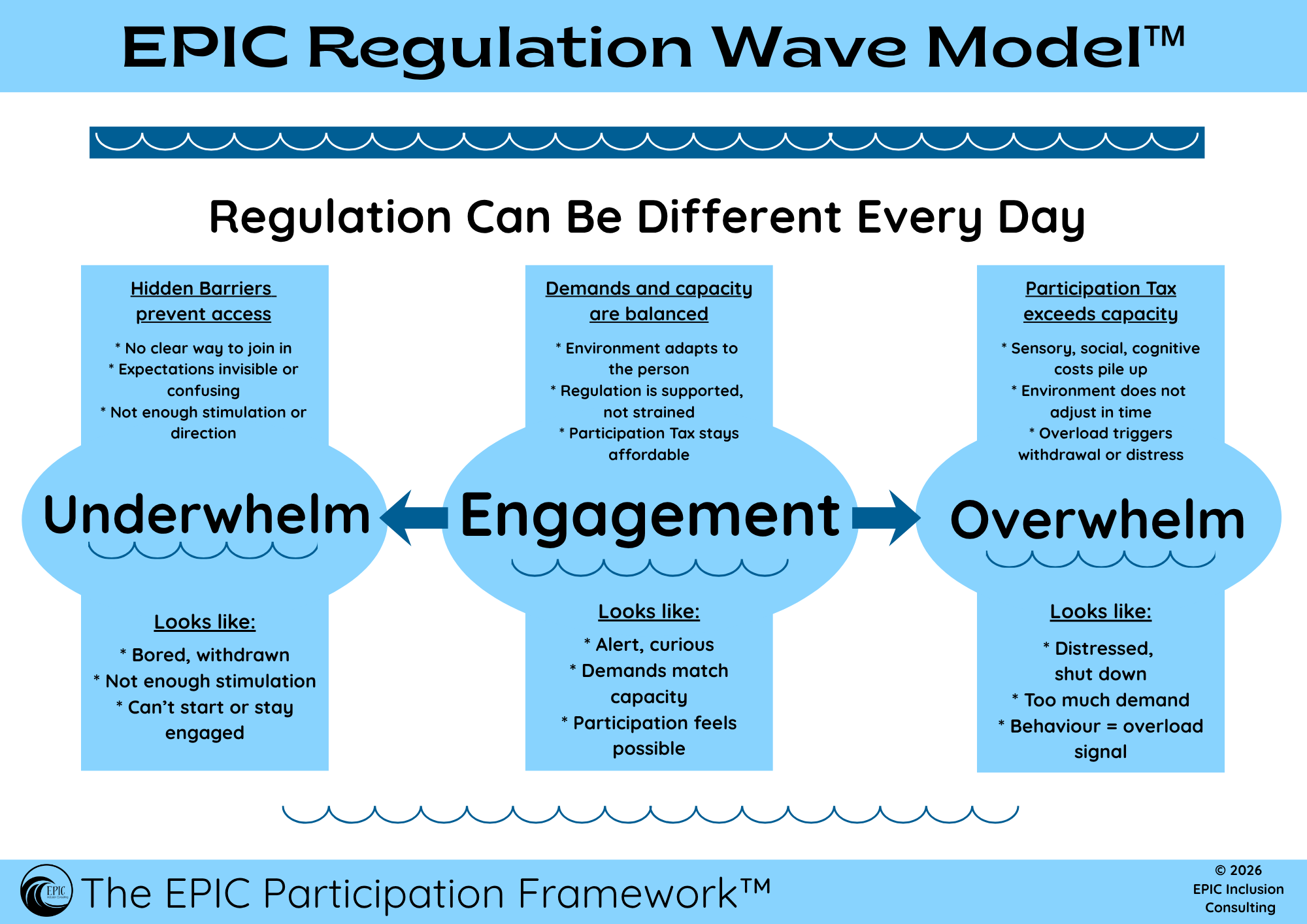
The EPIC Regulation Wave Model™, showing Underwhelmed, Engaged and Overwhelmed states
I wrote a full post on the Regulation Wave that goes into more detail, but the short version is: where a child is on the wave changes what they need from us.
Co-regulation is how we support children to move from Underwhelmed or Overwhelmed back into Engaged, and protecting that engaged state when they're in it.
What co-regulation looks like in practice
Co-regulation isn't just a set of techniques to pull out when a child is struggling. It's about showing up with calm presence and adjusting as you go to where the child is on the Regulation Wave.
When a child is showing early signs of stress (fidgeting, tense shoulders, going quiet):
Lower your voice and slow down your movements
Offer a choice: "Would you like to sit on the mat or at the table?"
Suggest a break before it's needed: "Let's get a drink of water together."
Reduce demands: "You don't have to finish this right now."
When a child is already overwhelmed (meltdown, shutdown, panic):
Stop talking. Your words are extra noise.
Stay nearby, calm, and quiet. Your presence is the support.
Reduce sensory input. Dim lights or move to a quieter space.
Do not demand eye contact, explanations, or compliance. They may not have the capacity to give it.
When a child is underwhelmed (bored, zoning out, restless):
Add gentle input like a movement break, a fidget tool or a change of task.
Engage them with a preferred interest.
Offer a choice: "Would you like to draw or write?"
Check if they need connection - a quiet one-on-one moment can reset engagement.
Protecting the Engaged state (when things are going well):
Maintain predictable routines and visual schedules
Keep sensory load manageable (quiet spaces, soft lighting, fewer distractions)
Offer warm, calm greetings at the start of each session
Notice and name what's working: "You're really focused today."
Protect this state - don't introduce sudden changes without warning
What this means for educators and program leaders
Here's the thing about co-regulation... you're already doing it, whether you know it or not. Children pick up on your energy, your voice, your body language. The mind shift is simply about doing it on purpose.
Here’s how you can make co-regulation intentional:
Model calm. Your nervous system influences theirs. If you're rushed and stressed, children will pick that up. Take a breath before you respond.
Use predictability as a regulation tool. When children know what's coming, their nervous systems stay calmer. Visual schedules, consistent routines, and warnings before changes all count as co-regulation.
Create a regulation corner. Not a timeout, but a safe, quiet space with soft lighting, a cushion, and simple calming tools. Children can go there without punishment. You can go with them to co-regulate.
Stop saying "calm down." Instead, try saying "I'm here. Let's take a breath together." Or simply sit quietly beside them.
Share the work. Co-regulation means you don't expect a child to manage their emotions alone. You're a partner in working through their emotions, not in charge of fixing them.
Read the wave. Notice where the child is (Underwhelmed, Engaged, or Overwhelmed) and respond accordingly. A child who needs more input needs a very different response from a child who needs less.
For parents reading this:
You already know how to co-regulate. You've been doing it since they were born… holding them close, speaking softly, and staying calm when they couldn't. Trust those instincts. Your calm presence matters more than any strategy.
You also know what works best for your child. You know what helps them settle, what overwhelms them, and what brings them back. Share this information with their teacher or program leader. A simple conversation can make a huge difference: "When my child is overwhelmed or underwhelmed, here's what usually helps."
You're the expert on your child. Sharing that knowledge helps the adults around them co-regulate more effectively.
You don't have to do this perfectly
The EPIC Participation Framework™ helps educators and program leaders understand co-regulation and design environments that support it. If this resonates and you'd like to talk about what it might look like in your context, I'd love to chat.
One last thought
Co-regulation isn't about fixing children's emotions. It's about being present while they feel them. When you offer your calm and share the work of regulation, children learn they don't have to carry big feelings alone. That safety can shape how they handle feelings for the rest of their lives.
Visit these pages for more information:
Blog Post: The Regulation Wave: A Reasonable Neurodivergent Crash Out
Blog Post: Hidden Expectations & Hidden Barriers: The Rules No One Tells You & The Challenges No One Sees.
Blog Post: The Participation Pathway: Why Some Children Check Out Before Participation Begins
Blog Post: That Hidden Cost of Joining In (And Why Some Kids Pay More)