Returnability: The Measure of Inclusion That Actually Matters
Estimated Reading Time: 4-5 minutes
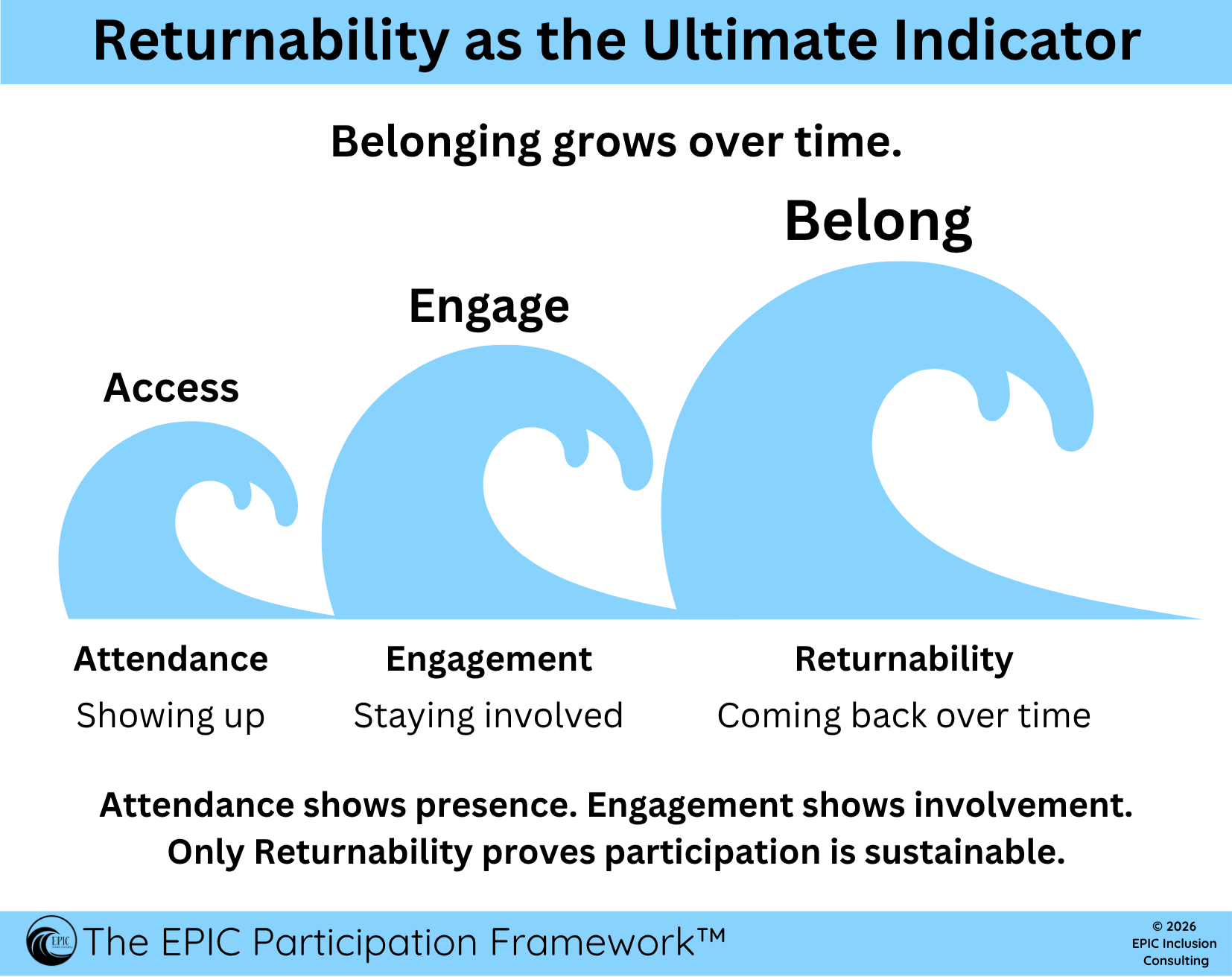
A full attendance roll doesn't tell you whether every child feels like they belong. It tells you they showed up, but it doesn't tell you whether they wanted to, or whether they'll want to again.
In schools and community programs, tracking attendance and behaviour can tell us a lot about when a child is struggling, particularly for neurodivergent children. But neither of these measures tells us what they carried home afterwards, or how they felt about returning next time.
The EPIC Participation Framework asks us to look at something else entirely, because the most honest measure of inclusion isn't attendance or behaviour. It's whether a child wants to, and feels able to, come back.
That's Returnability.
Returnability as the Ultimate Indicator
What is Returnability?
Returnability asks a simple question: does this child want to, and feel able to, come back?
Not because they have to, or because a parent is making them, or because they're pushing through exhaustion and masking until home time. But because the conditions are supportive enough that they genuinely want to return, again and again, over time.
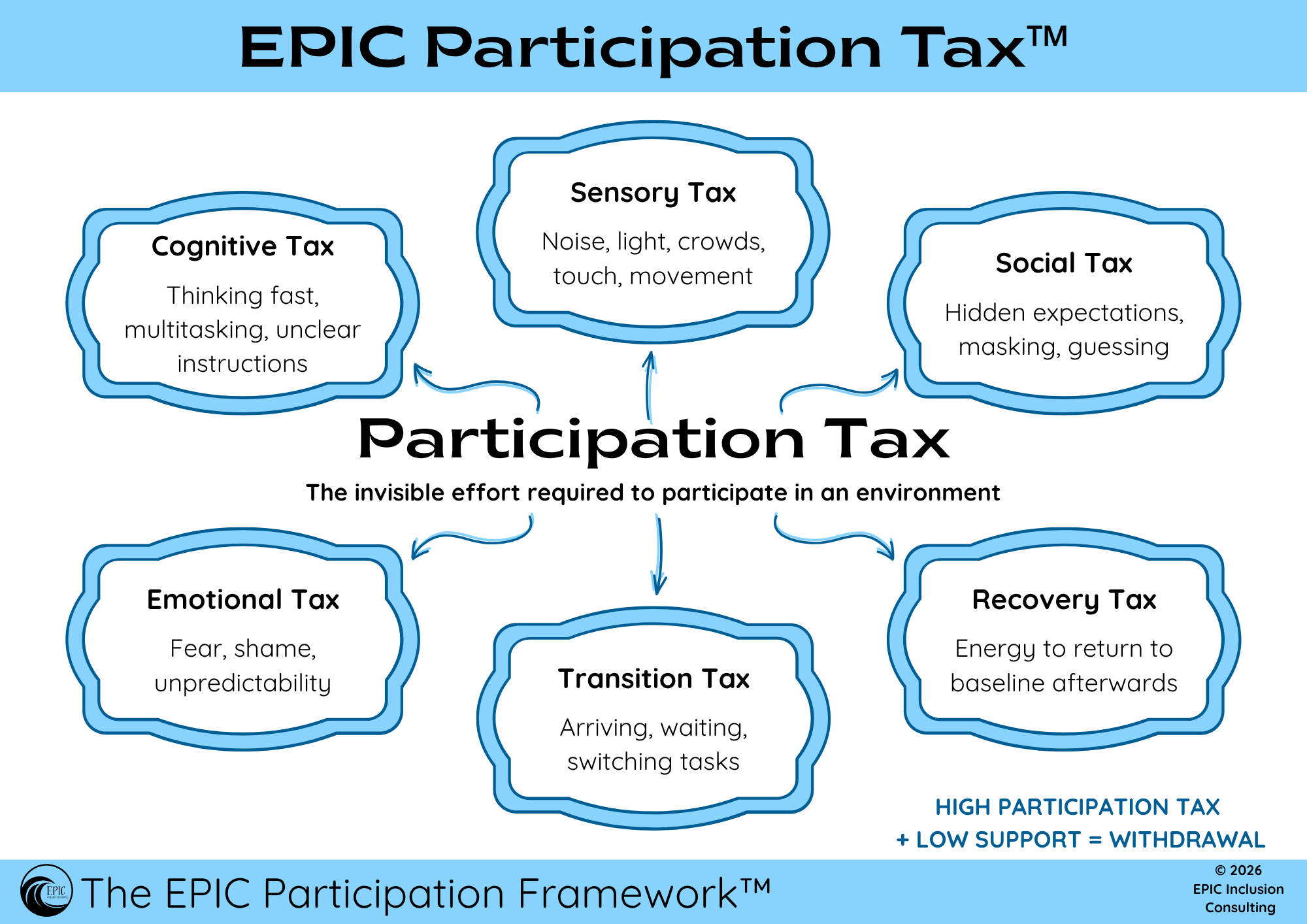
I often write about the Participation Tax - the hidden cost we pay to participate. For neurodivergent people, this can include the energy spent managing sensory input, processing unpredictability, masking, and holding it together in environments that weren’t designed to support them. A child can attend every class without obvious struggle and still be paying an enormous Participation Tax every single time. Returnability is one of the truest signals of whether the tax has become too high.
The EPIC Participation Tax
You can read more about the Participation Tax here.
A neurodivergent child could attend every lesson, follow every instruction, engage in every activity, and still be melting down at home each afternoon, dreading the next session, or quietly counting down to the holidays. If they stop returning, or if returning feels like a battle, that's not a child failing to cope. That's information telling us the environment isn’t manageable.
What Returnability looks like
Returnability isn't just about whether a child comes back. A child can return to a community program every week because their parents want them there, and still not experience Returnability at all. And in schools, a child can attend every single day while their genuine willingness to be there is close to zero. In both settings, the attendance record can look perfectly fine while the experience isn't.
Returnability also looks different in different contexts. Inschools, compulsory attendance removes the most obvious indicator - children have no choice but to return. In community programs, parents may want them to continue attending, even when the child doesn’t want to. In both cases, the adults that support neurodivergent kids need to know what to look for, and it isn’t showing up.
Instead of relying on attendance or behaviour, we can look for willingness signals.
In school settings, look for:
Does the child arrive with visible reluctance (slow walking, avoiding the classroom, finding reasons to go to the office or sick bay?)
Do they join in when supervised, but withdraw as soon as they can?
Do they start conversations or show interest when they don’t have to?
Do they ever choose to engage in optional tasks?
Do they return after an absence without excessive anxiety?
Do they seek you out for positive interactions, or do they avoid you and others?
Do their parents notice dread on Sunday night, or do you notice relief the moment the bell goes?
In community programs, look for:
Does the child seem willing, or are they clearly there because a parent has brought them?
Do they engage during sessions, or do they withdraw and wait for it to be over?
Do they ask for excessive breaks?
After a difficult session, do they return, and do they seem okay when they do?
Do they return after an absence without excessive anxiety?
Do they ever talk about the program positively, ask to bring a friend, or mention it at home?
In any setting, Returnability is never low due to a child's failure to cope. It means at least one participation condition still needs to change.
What this means for teachers and program leaders
No matter your context, the question to ask is “if this child had a real choice, would they be here?”
If the answer is no, or even maybe, don’t be discouraged - this is a good starting point! Ask yourself:
· Which participation condition is still failing?
· Is the Participation Tax too high?
· Are expectations unclear?
· Does the environment feel unpredictable or unsafe?
· Was there a difficult moment between you that was left unaddressed?
End every session with dignity.How a child leaves affects whether they want to come back. A calm goodbye, a genuine "see you next time" or a gentle word during a hard moment carries real weight. The last thing a child feels before they walk out shapes how they feel about coming back.
Repair after rupture.When something goes wrong (for example, a meltdown, a conflict, a miscommunication or a moment of exclusion) - don't just move on. Name it and explicitly welcome them back. "I'm sorry that moment was hard. I'm really glad you're here today." Repairing relationships and building trust can make returning feel possible, especially for children who carry shame easily.
Notice patterns, not just incidents. A single hard session doesn't tell you much. But a child who seems increasingly reluctant to arrive, whose anxiety is building rather than settling, or who has stopped initiating interaction is a pattern worth paying attention to. It's not a behaviour problem, it's a Returnability signal.
Ask families what they're seeing at home.Parents often know before we do. If a family mentions morning battles, tears before school, or "I don't want to go," that's valuable information, not a complaint to be managed. Treat it as data to change the environment.
For teachers:don't be fooled by 100% attendance. A child who hides at the back, never speaks, and runs out the door at the bell has full attendance and zero Returnability. Look past the roll to notice the willingness signals, or lack of signals.
For program leaders: when a family quietly disappears, consider reaching out. Not to fill a spot, but to genuinely ask what would have made it possible to stay. That feedback is some of the most useful information you'll ever receive, and most families never get the chance to give it.
For parents reading this
You usually know the truth about Returnability before anyone else does.
Your child's reluctance to return is information. The morning battles, the tears, the stomachaches, and the meltdowns are not drama, and it’s not avoidance for the sake of it. It's your child telling you, in the most honest way they can, that the Participation Tax is too high.
You can use this language with the teachers and program leaders in your child's life: "I'm noticing my child is struggling to want to come back. Can we talk about what's happening during sessions and what might help?"
A good educator or program leader will take that seriously. They'll talk about what the environment is doing, not what your child needs to do differently, and work with you to find a solution.
And if a community program, or even a school, genuinely isn't working? Leaving isn't failure. It's information for next time about what your child needs from an environment before they can truly belong.
One last thought
Returnability is belonging, proven over time. When a neurodivergent child wants to come back, it means something in the environment is working, and it means the cost of participating is affordable. It means belonging is REAL, and that’s what we’re trying to build.
What does Returnability look like in your context? What signals tell you a child genuinely wants to be there?
Visit these pages for more information:
Blog Post: Co-Regulation: Sharing the Work of Calming Down
Blog Post: The Regulation Wave: A Reasonable Neurodivergent Crash Out
Blog Post: Hidden Expectations & Hidden Barriers: The Rules No One Tells You & The Challenges No One Sees.
Blog Post: The Participation Pathway: Why Some Children Check Out Before Participation Begins
Blog Post: That Hidden Cost of Joining In (And Why Some Kids Pay More)