How to Build Returnability in Your Classroom or Community Program: A Practical Guide
Estimated Reading Time: 5-6 minutes
We often measure inclusion by attendance and participation. A full roll, good behaviour and the appearance of participation. Children who show up, do what’s expected, and don't cause trouble.
But none of these things tell you if a neurodivergent child feels like they actually belong in your setting. They tell you that this child showed up, but not whether they wanted to, or whether they’ll want to again.
And sometimes, it’s not even that obvious. Some neurodivergent children don’t withdraw or refuse. They learn to mask their challenges and pick up what the ‘right’ behaviours are, participating while barely belonging at all.
Inclusion without belonging isn't genuine inclusion. It's just presence.
Australia’s Disability Standards for Education 2005 detail the clear legal obligation of all principals and teachers to ensure every student can participate in the curriculum on the same basis as their peers, through rigorous, meaningful and dignified learning (Commonwealth of Australia, 2005). But attendance was never a true measure of inclusion, and neither is participation on it’s own. The truest measure is whether a child can, and wants to, come back and participate after previous experiences.
In the EPIC Participation Framework, I call this Returnability.
A quick recap
A few months ago, I wrote a post about Returnability, what it looks like for neurodivergent children and how to spot it in your setting. If you’d like to read about this in detail, you can do that here. Otherwise, here’s a quick summary.
Returnability is a genuine measure of inclusion, and focuses on one simple question: does this child want - and feel able - to return to the setting? I have seen (and experienced personally) how attendance and participation can absolutely occur without true feelings of inclusion and belonging. Returnability isn’t about attending because a parent insists, or because attendance is compulsory. It happens when the conditions are supportive enough that neurodivergent kids genuinely want to come back again and again.
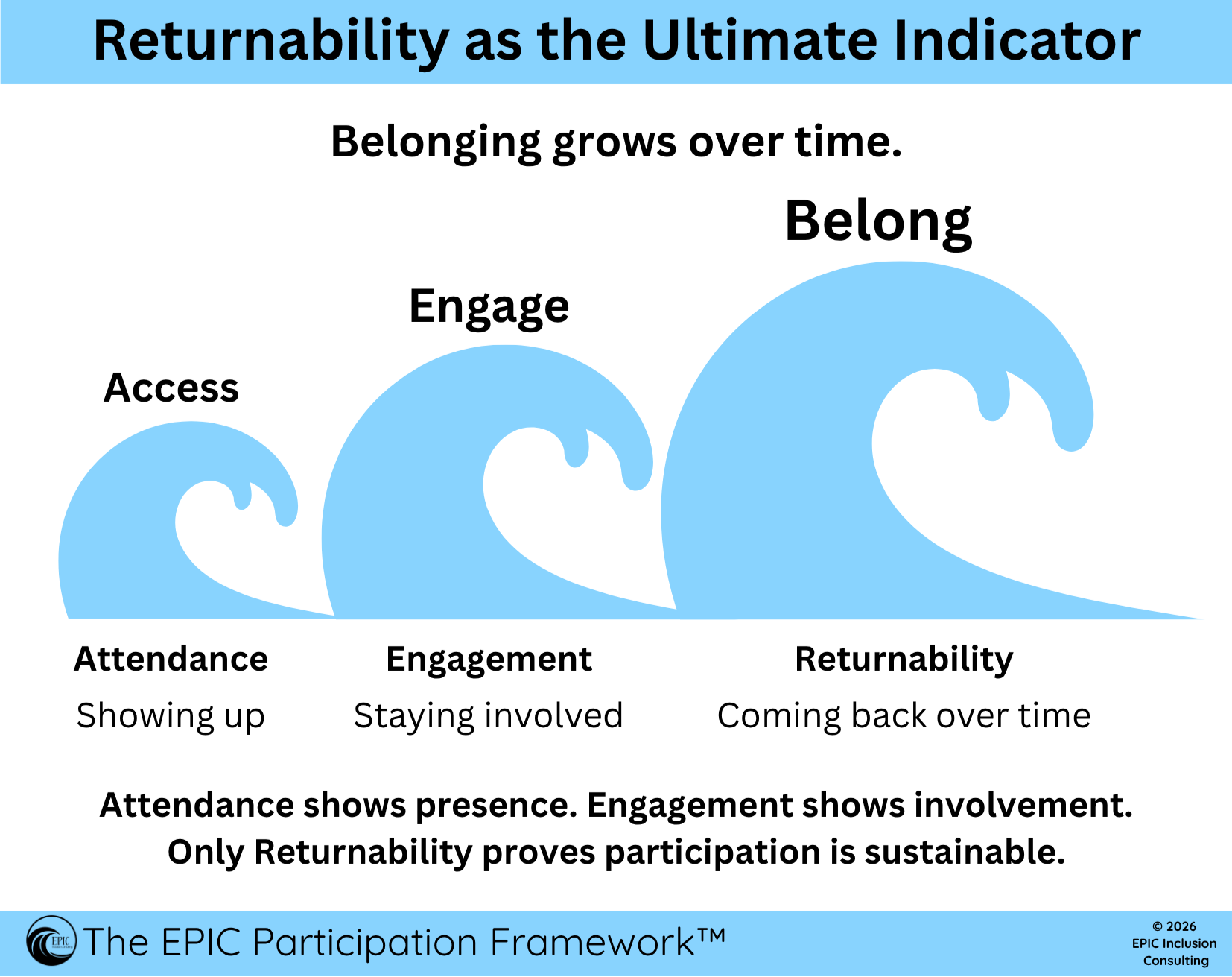
EPIC’s “Returnability as the Ultimate Indicator”
Returnability happens when five participation conditions are in place:
The Participation Tax is affordable
The child can manage their own energy in the environment
Expectations are clear and predictable
The environment changes when participation gets hard
The child feels genuinely safe
When Returnability is low, it’s never a child's fault, or their failure to cope. It means at least one of these 5 conditions still needs work. When a child stops returning, or when returning feels like a battle, this should be seen as feedback about the environment, not proof that something is wrong with them (Dwyer, 2024).
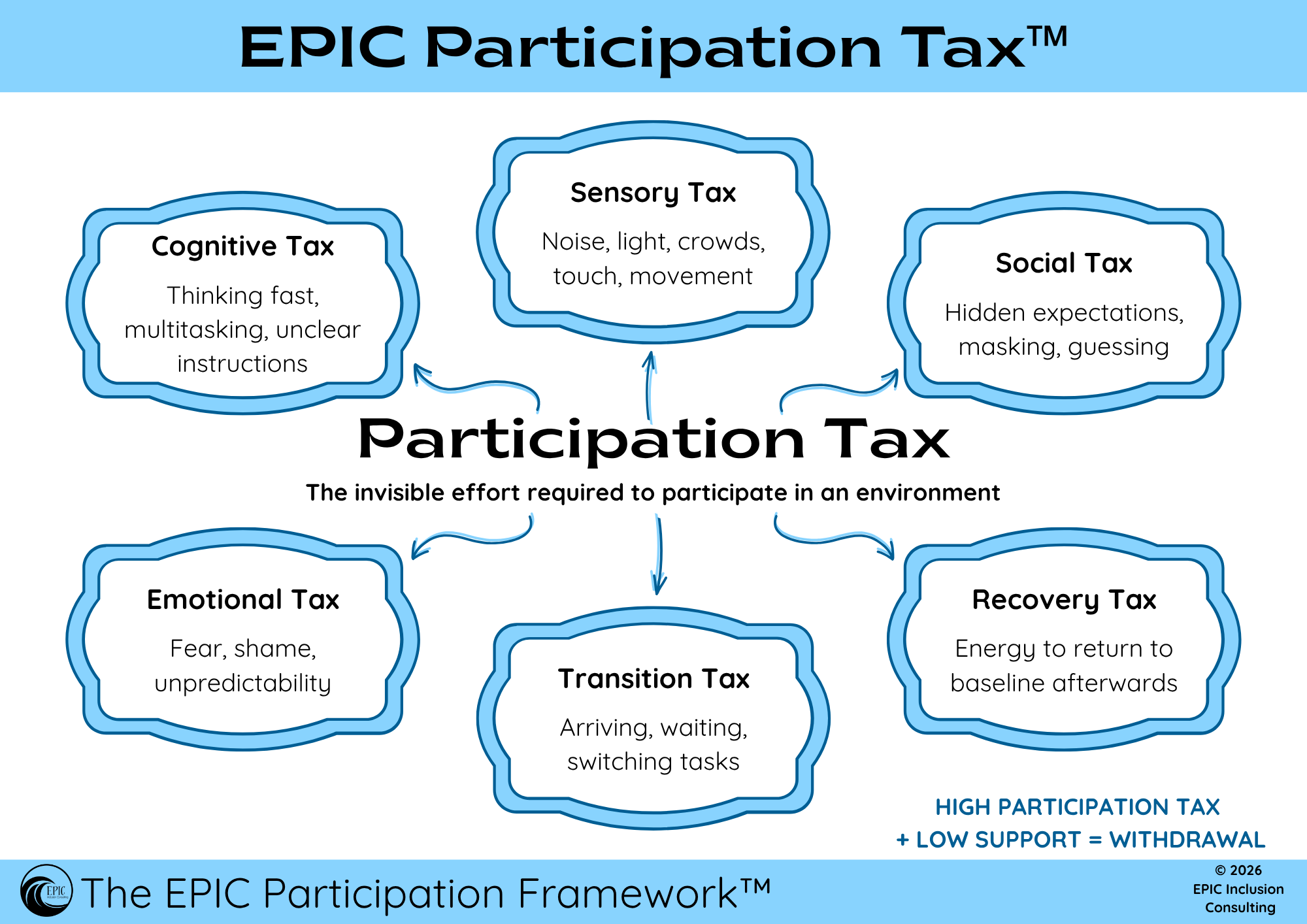
EPIC’s Six Types of Participation Tax
Returnability in compulsory settings - what teachers need to know
In schools, attendance is compulsory. When children have no choice about showing up, attendance can’t be used to measure whether a child wants to be there. A student, particularly one who is neurodivergent, can attend every single day, participate in every activity, and still can’t wait to leave at the end of the day, with no true feelings of belonging and zero Returnability. Even if their attendance and participation records look fine, their experiences might not be.
One of the most important things a teacher can understand is that Returnability can be difficult to spot in settings where children are lawfully compelled to attend.
Instead, teachers can look for willingness signals - signs of genuine engagement that go beyond compliance to attend.
Does the child arrive with visible reluctance; for example, slow walking, avoiding the classroom, finding reasons to visit the office or sick bay?
Do they participate when closely supervised, but withdraw the moment they can?
Do they show relief when the bell goes, or do parents report dread on Sunday night?
Do they ever choose to stay for something optional, or do they leave the moment they're allowed to?
Do they initiate conversations or show genuine interest when they're not required to?
Do they return after a sick day without excessive anxiety?
Do they seek you out, or avoid you?
Do they ever refuse school entirely? School refusal is one of the most significant Returnability signals of all - and one of the most commonly misread as a behaviour problem.
When a neurodivergent student attends every day, hides at the back, never speaks, and runs out the door at the bell, it’s pretty clear that they have 100% attendance and zero Returnability. But neurodivergent children who have learned to mask might answer questions, follow instructions, meet expectations and appear calm and engaged when, in reality, they’ve checked out internally. Many neurodivergent students spend energy to manage the “performance” of participation, rather than actually experiencing it, so while everything looks good from the outside, they’re paying an enormous internal cost to join in.
The question is, if your neurodivergent students had a real choice, would they still come?
If the answer is no, or even maybe, that's your sign to investigate which participation conditions are still failing that child.
Returnability in non-compulsory settings - what program leaders need to know
In community programs, sport, and extracurricular settings, the most obvious Returnability signal is whether the child comes back at all. But it's not the only one, and it’s not always accurate. A child may return every week because a parent expects them to attend, not because they truly want to be there.
Even in community settings, willingness signals in neurodivergent children to continue to attend can give a lot of information.
Does the child seem willing, or are they clearly there because a parent has brought them?
Do they engage during sessions, or withdraw and wait for it to be over?
After a difficult session, do they return, and do they seem okay when they do?
Do parents ever mention them talking about the program positively at home?
Do they ever ask to bring a friend?
Do they return after a break without significant reluctance or distress?
Do they start interactions with peers or leaders, or avoid them?
If you’re not seeing signals that a neurodivergent child is willing to attend, or when a family quietly disappears from your program, it helps to consider which participation conditions need improvement. Fortunately, Returnability is something you can build into your setting.
How to build Returnability
Returnability isn't built through perfect attendance, participation or behaviour. It builds through consistent conditions that make coming back feel safe, possible, and worth the internal cost.
1. Create a genuine sense of safety before anything goes wrong
Real inclusion and belonging grow from repeated safe participation experiences. Each time a neurodivergent child joins in and feels safe, a little more trust is built, and over time, that trust becomes a real sense of belonging (Raising Children Network, 2025a).
In practice, this means predictable routines, clear expectations, quiet spaces, warm and consistent greetings, and a physical environment that doesn't overwhelm them. A child who arrives not knowing what to expect or do is already paying a higher Participation Tax before the session has even begun.
2. End every session with dignity
How a child leaves your setting shapes how they feel about coming back next time. A calm goodbye, a genuine "see you next time," or a quiet word after a hard moment can carry real weight, especially for neurodivergent children who may carry that last interaction with them for a lot longer. It’s easy to do this after a good day, but it matters the most after a challenging one.
Avoid ending sessions with consequences, unresolved conflict, or shame, because that final moment matters.
3. Repair after rupture
When something goes wrong, such as a meltdown, a conflict, or a miscommunication, don't just move on. Repairing the situation matters enormously. It helps to name what happened and explicitly welcome the child back. "I'm sorry that moment was hard. I'm really glad you're here today."
For neurodivergent children who carry shame easily, unrepaired ruptures become participation barriers. A child who leaves a class or session feeling humiliated or misunderstood carries that into every future interaction with your setting. Repair removes that barrier before it takes hold.
4. Notice patterns, not just incidents
A single hard session doesn’t tell you much. But when a neurodivergent child seems increasingly reluctant to arrive, if their anxiety is building rather than settling down, or if they stop initiating interactions, it’s worth paying attention. Because that’s not a behaviour problem, it’s a Returnability signal.
In these situations, keep it simple. After each day or session, ask yourself if this child genuinely seemed like they wanted to be there. If the answer is no or maybe, look at which participation conditions might be triggering it.
5. Ask families what they're seeing at home
Parents and carers are the experts on their children. Morning battles, tears before school, meltdowns after school, and stomach aches without medical cause on activity days are all signs of low Returnability, not drama. Don’t treat this information as a complaint about your setting, but as data you can use to make it easier for neurodivergent children to return.
Ask parents directly and listen without defensiveness. Asking what would make it easier for their child to return can open up some incredibly insightful conversations, and show families that inclusion and belonging are genuinely important in your setting.
6. Reach out when connection breaks down
When a family stops coming to a community program, consider reaching out. This isn’t about filling a spot, but about genuinely wanting to learn and improve participation conditions. Most families never get that question, and even if they don’t return, you’ll likely learn valuable information to support future neurodivergent children in your setting.
In schools, families don’t stop coming, but they do sometimes pull away, stop communicating, or disengage from the relationship with your setting. Reaching out early, before the gap widens, is one of the most effective things you can do for a child’s long-term Returnability in school.
For parents reading this
You know your child’s Returnability better than anyone, and that knowledge can make you a powerful advocate in their corner. If something feels off, trust that. It doesn’t mean anyone did anything wrong, but it does mean a participation condition needs attention.
It can help to mention to their teacher or program leader that you’ve noticed your child is struggling to want to be there, so that you can work together to identify what is making things harder and what can change. A good educator or program leader will focus on how the environment can better support your child, not on what your child should do differently.
But if a community program truly isn’t working for your child, leaving isn’t failure. You can use this experience as information for next time about what your child needs before they can truly belong in a setting.
About the EPIC Participation Framework
Returnability is one of the central concepts in the EPIC Participation Framework, which I'm putting the finishing touches on. If you'd like to be among the first to know when educator and program leader training becomes available, follow me for updates - and if you'd like support in your setting in the meantime, I'd love to chat.
One last thought
When a neurodivergent child wants to keep coming back to a setting, it means something in that environment is working. Returnability is possible when the cost of participating is affordable, when participation conditions are supportive enough, and when the sense of belonging is real. That’s inclusion doing what it’s meant to do.
References
Commonwealth of Australia. (2005). Disability Standards for Education 2005. Australian Government Department of Education. https://www.education.gov.au/disability-standards-education-2005
Dwyer, P. (2024). Eight principles of neuro-inclusion: An autistic perspective on innovating inclusive research methods. Frontiers in Psychology, 15. https://www.frontiersin.org/journals/psychology/articles/10.3389/fpsyg.2024.1326536/full
Raising Children Network. (2025). Inclusion for your child with disability, autism or ADHD. https://raisingchildren.net.au/disability/disability-rights-the-law/rights/inclusion-children-with-disability-developmental-delay-autism
Visit these pages for more information:
How-To Series:
Blog Post: What Neurodivergent Behaviour Is Really Telling You: A Practical Guide to the Regulation Wave
Blog Post: The Rules No One Taught: How to Spot Hidden Expectations in Your Classroom or Program
EPIC Framework Concept Series
Blog Post: Just Being in the Room Isn't Enough - Participation Without Belonging
Blog Post: Returnability: The Measure of Inclusion That Actually Matters
Blog Post: The Regulation Wave: A Reasonable Neurodivergent Crash Out
Blog Post: Hidden Expectations & Hidden Barriers: The Rules No One Tells You & The Challenges No One Sees.
Blog Post: The Participation Pathway: Why Some Children Check Out Before Participation Begins
Blog Post: That Hidden Cost of Joining In (And Why Some Kids Pay More)
EPIC Website Info