The Rules No One Taught: How to Spot Hidden Expectations in Your Classroom or Program
Estimated Reading Time: 4-5 minutes
When a neurodivergent child seems confused, frustrated, or "difficult" (and you can't work out why), there’s a good chance that Hidden Expectations are part of the picture.
Hidden Expectations are the unspoken rules that children are expected to know but were never actually taught. They're the instructions we've internalised so completely that we forget they need explaining. And for neurodivergent children, who may not pick up on social cues, imitation, or unspoken norms the way their peers do, hidden expectations can create invisible barriers that look like defiance, disengagement, or lack of effort - but aren't.
Children can't meet expectations they can't see. And when they fail to meet them, they often don't understand why - which makes the experience confusing, shaming, and discouraging.
The good news is that once you know what to look for, you can start making the invisible visible.
What Hidden Expectations look like
They show up everywhere. They’re in classrooms, on sports fields, and in community programs, and include things like:
"Wait your turn" - but how does a child know when it's their turn?
"Ask for help" - but what's the right way to ask in this space?
"Be respectful" - but what does that actually look like here?
"Pay attention" - does that mean still body, eye contact, hands in lap?
"Join the group" - but where? What do you say? What's the unspoken social script?
"Be a team player" - but what does that mean in practice, today, in this group?
These aren't unreasonable expectations. They're just ‘invisible’, and for neurodivergent children, invisible is the same as impossible.
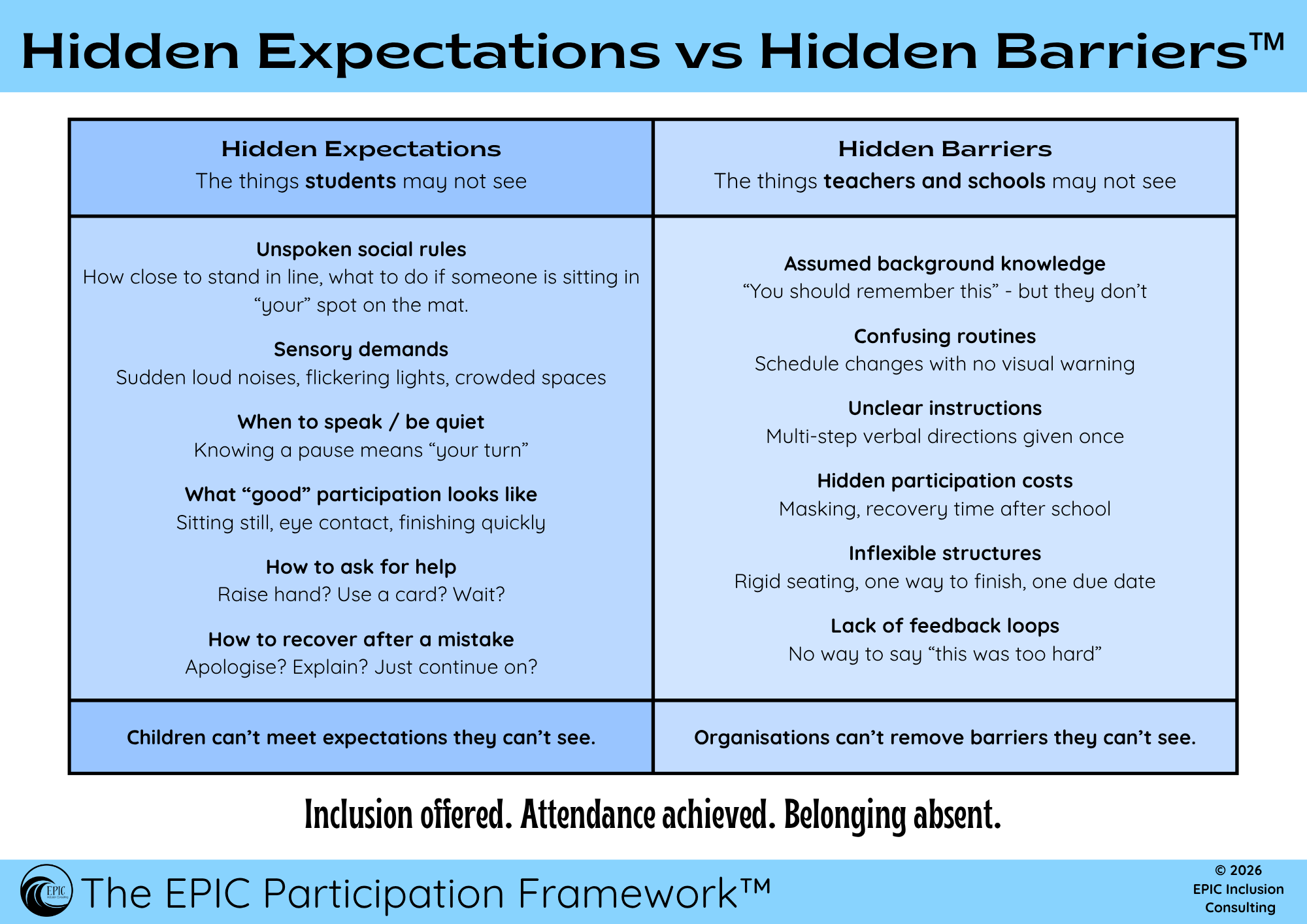
EPIC Hidden Expectations vs. Hidden Barriers™
How to spot them: a step-by-step guide
Step 1: Walk through your setting as a first-time child
Start from the moment a child arrives. What do they see? What do they need to know? What would they get "wrong" without meaning to? Write down everything a child needs to know to participate successfully in your classroom or program - then ask yourself honestly: which of these did I actually teach?
Step 2: Ask different questions
Instead of "what are my rules?" ask "what rules do I assume children already know?" Try this with a colleague. You'll both be surprised by how many invisible expectations you share - and how rarely they've been taught explicitly.
Step 3: Notice what children get "wrong"
When a neurodivergent child does something unexpected, pause before correcting them. Ask yourself “was this ever taught? Or was it assumed they knew?” The behaviours that frustrate us most are sometimes the ones we never taught in the first place.
Step 4: Ask a child or a parent
Children are often the best detectives when it comes to Hidden Expectations - they just don't always say it out loud. If you can, ask a child or parent: "Is there anything we expect here that we've never really explained?" Their answers can be genuinely revealing.
Step 5: Make the expectation visible
Once you've spotted a Hidden Expectation, the next step is simple - make it explicit. The section below has practical ideas for how to do that.
What to do once you've spotted them
Making Hidden Expectations visible doesn't have to be complicated. Here’s how you can do it:
Teach it explicitly - demonstrate it, practise it, and don't assume it will be naturally absorbed over time.
Use visuals - rule cards, picture prompts, and visual schedules reduce reliance on remembering instructions and are especially helpful for neurodivergent children.
Check for understanding - ask the group directly "What do we do when we line up?" or "How do we ask for help in this classroom?" You'll quickly see what's landed and what's still invisible.
Be specific - instead of "be respectful," try "in this room, respectful looks like listening when someone else is speaking and keeping your hands to yourself".
Revisit regularly - Hidden Expectations creep back in over time; a quick review every term keeps them visible.
Celebrate when children get it right - neurodivergent children who've spent years failing invisible rules need to know when they've got it.
Making expectations visible can change a child's entire experience, allowing them to fully participate and achieve a sense of belonging.
For parents reading this
If your child has been labelled "difficult" or "not listening," Hidden Expectations might be part of what's happening. You can bring this language into a conversation with their teacher or program leader: "I wonder if my child wasn't quite sure what was expected there. Could we talk about what the unspoken rules are?"
A simple, collaborative conversation is often all it takes to start shifting things.
About the EPIC Participation Framework
Hidden Expectations are one of the participation conditions explored in the EPIC Participation Framework - my practical, systems-based framework currently in development for educators and program leaders. Training is coming soon. Follow me for updates, or if you'd like to talk about consulting support in the meantime, I'd love to hear from you.
One last thought
Hidden Expectations aren't anyone's fault. They're just… invisible. But once you see them, you can change them - and when you do, neurodivergent children stop guessing and start belonging.
Visit these pages for more information:
Blog Post: Just Being in the Room Isn't Enough - Participation Without Belonging
Blog Post: Returnability: The Measure of Inclusion That Actually Matters
Blog Post: Co-Regulation: Sharing the Work of Calming Down
Blog Post: The Regulation Wave: A Reasonable Neurodivergent Crash Out
Blog Post: Hidden Expectations & Hidden Barriers: The Rules No One Tells You & The Challenges No One Sees.
Blog Post: The Participation Pathway: Why Some Children Check Out Before Participation Begins
Blog Post: That Hidden Cost of Joining In (And Why Some Kids Pay More)