When Participation Costs Too Much: A Guide to Lowering the Participation Tax in Your Classroom or Program
Estimated Reading Time: 4-5 minutes
Participation struggles aren’t always visible.
A student who participates and complies all week might crash on the weekend. A child who seems to cope well during the day falls apart at home. Or they quietly stop coming back to community programs altogether.
That's the Participation Tax at work.
The Participation Tax is the hidden effort required to participate in any environment. Everyone pays this tax, but for neurodivergent children, it’s often significantly higher, accumulates faster, and doesn't stop when the session ends. It often shows up in exhaustion, anxiety, meltdowns, and reluctance to return.
Neurodivergent children shouldn't have to pay such a high cost just to participate. We can support them better, in classrooms and community programs, by lowering the Participation Tax. This post walks you through practical ways to lower those costs in your setting.
What makes up the Participation Tax?
The Participation Tax has six parts, each adding hidden effort that most people never see. As an AuDHD teacher and community instructor, I see these costs from both sides - in the children I work with, and in my own experience of navigating the same environments:
Sensory Tax - coping with noise, bright lights, crowds, smells, or too much movement
Cognitive Tax - processing unclear instructions, remembering steps, or managing too many demands at once
Social Tax - navigating unwritten rules, reading social cues, and masking natural behaviours
Emotional Tax - managing fear of getting it wrong, past shame, not “fitting in”, or not knowing what comes next
Transition Tax - the effort of arriving, waiting, and switching between activities without warning or verbal assurances
Recovery Tax - the energy needed after participation just to return to baseline
For neurodivergent children, these taxes build up quickly. Without regular opportunities to regulate their nervous system, children hold the cost in until they reach a safe place to let it out, which is often home. A child might seem completely fine during the session, but the tax has been quietly building the whole time.
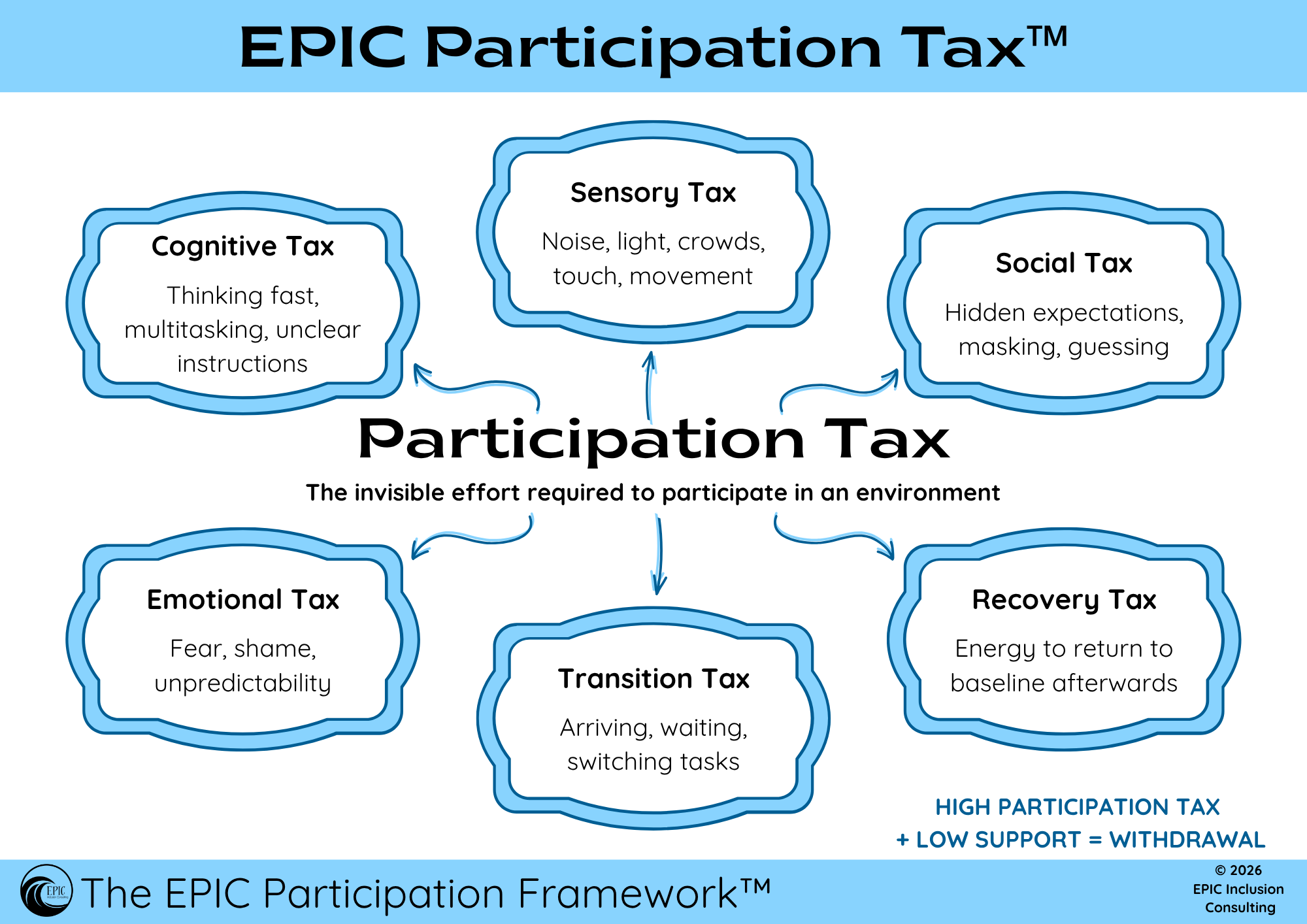
The Six Participation Tax Types
Step 1: Identify where the tax is highest in your setting
You can't lower a tax you can't see. Start by walking through a typical day or session from a neurodivergent child's perspective. From the moment they arrive: what do they see and hear? What would confuse them? What would feel overwhelming? What would they need to remember? What happens at the end, and how do they leave?
Write down anything that might be adding to the tax. Then look for patterns: which activities or times of day seem to cost the most? When do you see the most avoidance, withdrawal, or distress? The answers will often point directly to a specific tax type, or combination of types.
Step 2: Lower the Sensory Tax
Small environmental changes can make a huge difference for neurodivergent children who are sensitive to sensory input.
Reduce noise where possible - soften echoes, use quieter materials, offer noise-reducing headphones
Offer dimmer or natural lighting where available
Reduce visual clutter on walls and displays
Create a calm corner or quiet space for breaks
Offer varied seating options - floor, cushion, chair, standing
Warn children in advance of loud or unexpected sounds like fire drills, alarms, or noisy activities
Be mindful of strong scents like cleaning products, air fresheners, and food smells
Build movement breaks into the session as a routine, not just a response to struggle
Use visual signals rather than auditory ones where possible
Step 3: Lower the Cognitive Tax
Cognitive demand is about how much thinking, processing, and remembering is needed to participate.
Use simple, clear language and break instructions into small steps
Use consistent language for routines to reduce processing load
Pair verbal instructions with visuals - written steps, picture prompts, or demonstrations
Model tasks before expecting independent work
Use visual schedules to reduce uncertainty about what comes next
Allow assistive tools like timers, checklists and reminder cards
Allow processing time before expecting a response
Avoid open-ended tasks without structure
Step 4: Lower the Social Tax
For neurodivergent children, the social rules of a classroom or program are often invisible and expensive.
Make social expectations explicit rather than assumed
Teach social rules directly - how to ask for help, how to join a group, how to take a turn
Provide sentence starters or scripts for situations neurodivergent children find difficult
Offer structured roles in group activities to reduce social guesswork
Avoid expecting eye contact as a signal of attention or respect
Offer a pre-agreed signal for when social situations become overwhelming
Increase adult support during unstructured social time
Step 5: Lower the Emotional Tax
The Emotional Tax is about fear, shame, unpredictability, and the weight of past experiences.
Build trust through consistency and warm, predictable interactions
Acknowledge effort, not just outcome
Respond to mistakes with curiosity rather than correction or blame
Avoid public correction or drawing attention to mistakes in front of peers
Avoid shame-based language - focus on what's possible, not what went wrong
Repair relationships after difficult moments - a simple "I'm glad you're here today" matters
Give advance notice of even small changes to routine as predictability reduces emotional load
Use a calm, regulated tone - neurodivergent children co-regulate from the adults around them
Step 6: Lower the Transition Tax
Transitions - between activities, spaces, or states - are a significant source of hidden cost for many neurodivergent children.
Provide warnings before changes: visual timers, gentle verbal reminders, or a predictable signal
Keep transition expectations and sequences clear and consistent
Use first-then language: "First we finish this, then we move to..."
Build in buffer time rather than moving directly from one demand to the next
Reduce the number of transitions where possible
Use a consistent arrival and departure ritual reduces the cost of entering and leaving the space
Step 7: Lower the Recovery Tax
The Recovery Tax is easy to overlook - but how a day or session ends affects whether a neurodivergent child wants to come back.
End sessions calmly and positively, without rushing children out the door
Offer a consistent, warm goodbye routine
Allow time to regulate after demanding activities before transitioning home
Build regular regulation opportunities throughout the session to reduce how much recovery is needed afterwards
Avoid scheduling demanding activities at the very end of a session
Avoid introducing new information or expectations in the final few minutes
Let families know what to expect - a heads-up about a hard day or session helps parents support recovery at home
One step at a time
You don't need to tackle all of this at once, and lowering the Participation Tax takes time. Start with the tax type that showed up most clearly in Step 1, make one practical change, and build from there. Small reductions add up, and for a neurodivergent child, a lower Participation Tax means more energy for connection, learning, and belonging.
For parents reading this
You're the ones who see the Participation Tax at home - the exhaustion, the meltdowns, the reluctance to go back. None of that reflects failure, but it is information that the cost of participating is too high.
You can bring this language into conversations with your child's teacher or program leader: "I'm noticing my child is exhausted/struggling after school, and I think the effort of the day is costing them more than we realise. Can we talk about what might be adding to that, and what we could adjust?" Most teachers and program leaders want to be genuinely inclusive, and a practical, collaborative conversation is often the starting point for real change.
About the EPIC Participation Framework
The Participation Tax is one of the concepts at the heart of the EPIC Participation Framework, which I'm currently putting the finishing touches on. If you'd like to be among the first to know when educator and program leader training becomes available, follow me for updates. And if you'd like support in your setting in the meantime, I'd love to hear from you.
One last thought
The Participation Tax is real, but we can do something about it. When you lower the tax, neurodivergent children relax, parents feel relief, and real belonging becomes possible.
Visit these pages for more information:
How-To Series:
EPIC Framework Concept Series
Blog Post: Just Being in the Room Isn't Enough - Participation Without Belonging
Blog Post: Returnability: The Measure of Inclusion That Actually Matters
Blog Post: The Regulation Wave: A Reasonable Neurodivergent Crash Out
Blog Post: Hidden Expectations & Hidden Barriers: The Rules No One Tells You & The Challenges No One Sees.
Blog Post: The Participation Pathway: Why Some Children Check Out Before Participation Begins
Blog Post: That Hidden Cost of Joining In (And Why Some Kids Pay More)
EPIC Website Info