Estimated Reading Time: 6-7 minutes
Our attention usually goes to the children who need our immediate support.
When supporting neurodivergent children in classrooms and community contexts, we tend to prioritise responding to distress or dysregulation. We often notice when they struggle, and step in to deescalate or co-regulate. On the other hand, when a neurodivergent child is calm, focused and engaged, it’s easy to take that for granted and give them less attention, particularly in busy environments. But these are the moments where learning and connection really happen, and what we do while children are in this state can determine whether they stay there.
In the EPIC Participation Framework, I call that sweet spot the Engaged state, where children (and adults!) are calm enough to participate, focused enough to learn, and safe enough to connect and belong. It's one of three states in the Regulation Wave, and neurodivergent children can move between those states faster and more intensely than others.
The framework helps us understand that participation works when regulation stays possible. Thinking, learning and collaboration all depend on nervous system regulation (Stimpunks Foundation, 2026), so the Engaged state isn’t just a happy, optional bonus - it’s what makes learning, connection and belonging possible in the first place.
I've used these strategies in my own classrooms and community programs, and I've also needed them for my AuDHD self and my own AuDHD kids. This post is a guide to protecting the Engaged state, whether you're supporting neurodivergent children in a classroom or a community program.
A quick recap: the Regulation Wave
The Regulation Wave describes the three states we all move between throughout the day.
Underwhelmed: not enough going on. Bored, restless, or seeking input.
Engaged: the sweet spot. Demands feel manageable and the child has the regulation resources they need.
Overwhelmed: too much is being asked. Meltdowns, shutdowns and withdrawal are overload, not behaviour.
Neurodivergent children move between these states faster and more intensely. You can read more about the Regulation Wave in my previous newsletters:
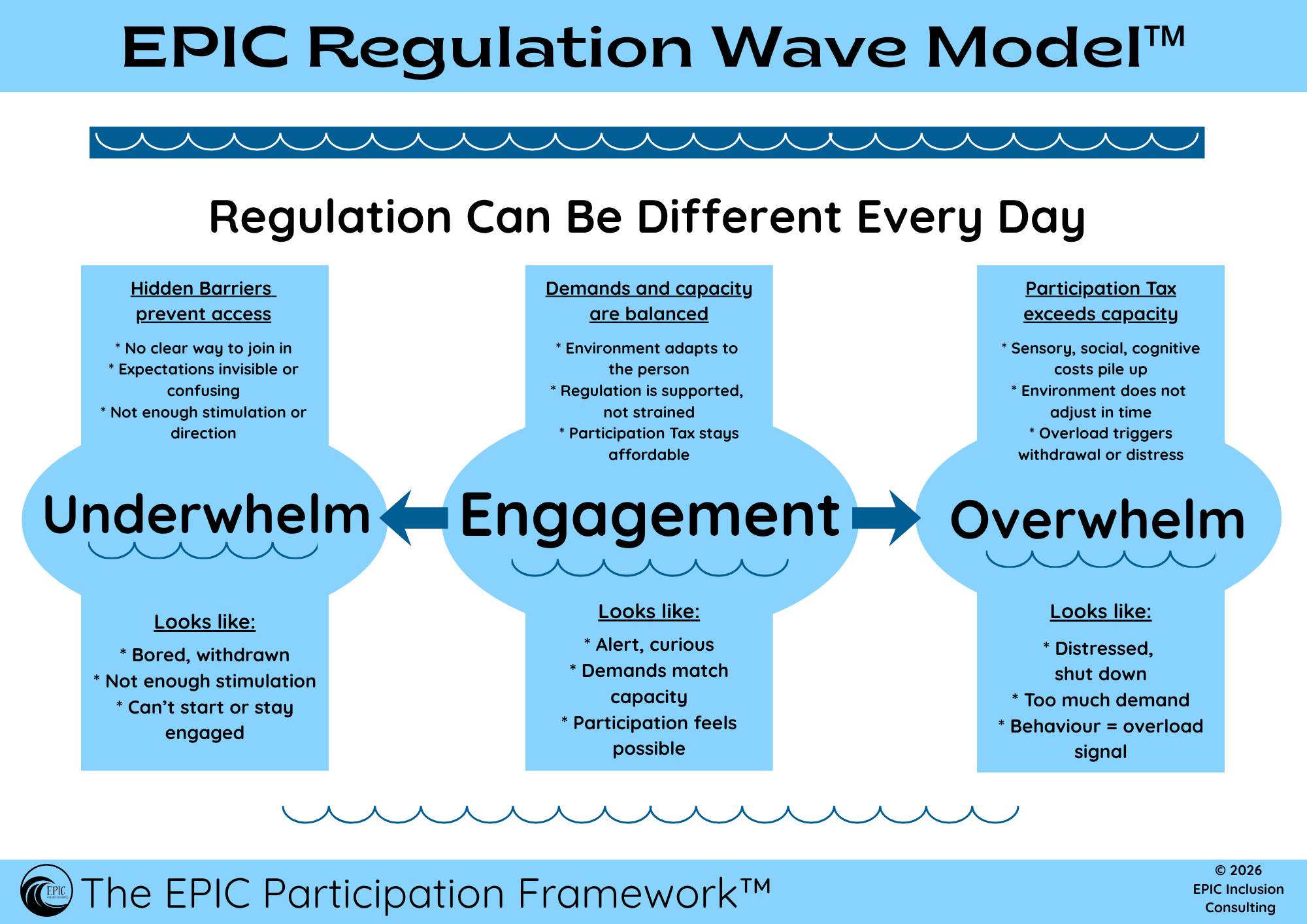
The EPIC Regulation Wave Model™
What the Engaged state can look like
The EPIC Participation Framework describes the Engaged state as the sweet spot where demands feel manageable, there's enough going on to stay interested, and the child has the regulation resources they need. Engaged doesn't mean perfect participation or obedience. In neurodivergent children, it might instead look like:
Calm, even breathing and a relaxed body
Eyes softly focused, even without direct eye contact
Responding to instructions or cues, even if there's a delay
Joining in at their own pace, watching quietly first and then participating
Small movements, humming or soft self-talk that help them regulate rather than disrupt others
Sometimes the best way to protect engagement is to leave the child alone and let it keep happening, while making sure the conditions around them stay steady. Don't interrupt, but don't let anything else do it either.
Every child is different, so it’s crucial to learn what engagement looks like for each neurodivergent child in your setting, ideally with input from their parents or carers. Once you notice it, protecting it is often about not disrupting what's already working.
What can pull a child out of the Engaged state
There are many things that can pull a neurodivergent child out of the Engaged state, even if those things are barely noticed by the other children and adults in your setting. These often include:
Sudden changes without warning
Sensory overload, such as noise, bright lights, strong smells or crowding
Unclear instructions or expectations
Rushed or unpredictable transitions
Social demands that feel overwhelming
Tiredness, hunger, stress or pain
Past experiences of failure or shame
Many of these things come from the environment rather than internally. Research with neurodivergent young people suggests that sensory overload, inconsistency and social judgement are the main external stressors they experience (Pavlopoulou et al., 2025), and this means we can do something about those stressors.
When a child slips out of the Engaged state, they may either drift toward Underwhelmed (zoning out, withdrawing) or Overwhelmed (meltdown, shutdown) states. The earlier you notice their change of state, the easier it is to guide them back.
How to protect the Engaged state
Protecting engagement is mostly about the environment, and small, consistent changes can really add up. Bradley and Vogt (2024) argue that a "felt sense of safety" matters as much as physical safety, and this feeling of safety is what allows neurodivergent children to enter the Engaged state. So how do we build the conditions that let a neurodivergent child become, and stay, engaged?
1. Keep routines predictable
When children know what's going to happen, their nervous systems don't have to work as hard. Predictability takes away the guesswork, so children can use their energy for participating rather than bracing for what might happen next.
Use visual schedules for the day, the week, or even a single activity
Follow routines consistently
Use the same signals for transitions each time
2. Keep sensory load manageable
Noise, light and crowding all add to the Sensory Tax, and for neurodivergent children that cost is usually much higher. Lowering it is one of the simplest ways to help a child stay engaged.
Offer a quiet space or calm corner
Use softer or natural lighting and reduce visual clutter
Offer varied seating, such as floor, cushion, chair or standing
Allow noise-reducing headphones
Be mindful of smells, noise, temperature and crowding
3. Start with a warm, calm welcome
Taking part starts before the activity does. How a child is greeted at the door helps them decide whether this feels like a safe place to be. A warm hello does more than you might think, whether in a classroom or a community session.
Greet each child by name in a calm, warm tone
Offer simple choices: "Would you like to sit here or there?"
Let them know you're glad they're there.
4. Notice and name what's working
Many neurodivergent children hear a lot about what they're getting wrong. They need to hear what they're getting right too, and being specific helps them feel seen and safe.
"You're really focused on that task."
"I noticed you helped your friend just now."
"You kept going even when it was tricky. That takes persistence."
"I can see you're working hard on that."
"You did that even though you were scared. That’s very brave. "
5. Give notice before changes
Unexpected changes and transitions can quickly and easily pull a neurodivergent child out of the Engaged state. When things feel unpredictable, it's much harder to think, remember and pay attention.
Give verbal warnings: "In five minutes, we'll be finishing up."
Use visual timers or countdowns
If a change can't be avoided, explain it clearly and simply
Offer extra support and compassion during transitions
6. Watch for early warning signs
When a child starts to fidget, tense up, go quiet or zone out, that's your cue. It means a mismatch has formed between what's being asked and what the child can manage right now, and responding early can prevent a slide into the Overwhelmed or Underwhelmed states.
Check in quietly: "How are you going with this?"
Offer a choice: "Would you like to keep going or take a quick break?"
Reduce demands: "You don't have to finish this part right now."
Add gentle movement or other sensory input if needed: "Let's stretch for a moment."
Helping a neurodivergent child back to the Engaged state
Sometimes, despite everyone's best efforts, a child will still slip into the Underwhelmed or Overwhelmed states. That isn't a failure on anyone’s part, but it is information we can use to make adjustments.
If they slip into the Underwhelmed state: add gentle input, such as movement, a fidget tool, a change of task, or a quiet moment of connection. Also check whether unclear expectations or a hidden barrier are making it hard to get started.
If they slip into the Overwhelmed state: stop talking, reduce sensory input, stay calm and present, and avoid demands.
The goal isn't to prevent every slip; it's to notice early and respond in a way that helps the child return to the Engaged state as smoothly as possible. For more on what helps in each state, see my original Regulation Wave post here.
Start with one change
You don't need to do all of this at once. Pick one change, such as a visual schedule, a warm greeting routine or a quiet corner, and build from there.
Community programs often have less built-in structure than classrooms, so predictable routines, a warm welcome and clear expectations can do a lot of the work for children who are still finding their feet in the space. In classrooms, the same changes can help children stay settled across a long day of transitions.
For parents reading this
You know better than anyone what helps your child stay settled and focused. Sharing that with their teacher or program leader helps everyone work together in a way that fits your child. You could say things like:
"My child does best when they know what's coming next. Visual schedules really help."
"They need quiet to focus. Would a calm corner be possible?"
You're the expert on your child. Don’t underestimate how valuable your knowledge is.
About the EPIC Participation Framework
The Regulation Wave is one of the concepts at the heart of the EPIC Participation Framework, which is almost complete. If you'd like to be among the first to know when educator and program leader training becomes available, follow me for updates, and if you'd like support in your setting in the meantime, I'd love to chat.
One last thought
When we protect the Engaged state, we do more than prevent meltdowns or zoning out. We create the conditions where learning, connection and belonging can grow, and that's where true inclusion begins.
References
Bradley, E., & Vogt, J. A. (2024). Engendering a feeling of safety as an ethical imperative in preventing emotional distress and behaviours that challenge services. In A. Bianchi & J. A. Vogt (Eds.), Intellectual Disabilities and Autism: Ethics and Practice (pp. 367–381). Springer. Retrieved from https://link.springer.com/chapter/10.1007/978-3-031-61565-8_27
Pavlopoulou, G., Chandler, S., Lukito, S., et al. (2025). Situating emotion regulation in autism and ADHD through neurodivergent adolescents' perspectives. Scientific Reports, 15, 37464. Retrieved from https://www.nature.com/articles/s41598-025-21208-x
Stimpunks Foundation. (2026). Pattern 07 - Regulation first. Stimpunks Library. Retrieved from https://stimpunks.org/patterns/library/regulation-first/
Visit these pages for more information:
How-To Series:
Blog Post: How to Build Returnability in Your Classroom or Community Program: A Practical Guide
Blog Post: What Neurodivergent Behaviour Is Really Telling You: A Practical Guide to the Regulation Wave
Blog Post: The Rules No One Taught: How to Spot Hidden Expectations in Your Classroom or Program
EPIC Framework Concept Series
Blog Post: Just Being in the Room Isn't Enough - Participation Without Belonging
Blog Post: Returnability: The Measure of Inclusion That Actually Matters
Blog Post: The Regulation Wave: A Reasonable Neurodivergent Crash Out
Blog Post: Hidden Expectations & Hidden Barriers: The Rules No One Tells You & The Challenges No One Sees.
Blog Post: The Participation Pathway: Why Some Children Check Out Before Participation Begins
Blog Post: That Hidden Cost of Joining In (And Why Some Kids Pay More)
EPIC Website Info