Estimated Reading Time: 5-6 minutes
It’s one thing to understand that children, especially neurodivergent children, benefit from co-regulation. But when a child is struggling in the middle of your lesson, session or activity, it can be hard to know what to do in the moment.
Co-regulation isn’t just a set of techniques to use, but a way of being present with a dysregulated child. It’s also the predictable routines, clear expectations, and sensory adjustments in the environment. This post looks at many co-regulation strategies I’ve used across classroom contexts, in my community program, and at home as a parent of autistic and ADHD children. In my experience, co-regulation principles are the same in every environment and work across all age groups, not just children. As an AuDHD adult, I can vouch for having the best outcomes when trusted people and calm environments help me regulate my big emotions and easily overloaded nervous system.
I recently wrote about the Regulation Wave, and what neurodivergent behaviour is actually telling you. You can read it . In this post, I use the Regulation Wave states to show how different co-regulation strategies can be used at different times to provide the most appropriate support. These three regulation states are:
Underwhelmed: not enough going on. Bored, restless, or seeking input.
Engaged: the sweet spot. Demands feel manageable and the child has the regulation resources they need.
Overwhelmed: too much is being asked. Meltdowns, shutdowns and withdrawal are overload, not bad behaviour.
Recognising what state a neurodivergent child is in gets you halfway there. The other half is knowing what to do to help them in that moment.
What co-regulation is, and where it comes from
Co-regulation is when a calm trusted person or a well-designed environment helps someone regulate their emotions or nervous system. Sharing the work of regulation means the dysregulated child (or adult) doesn’t have to do it alone, particularly when they’re still learning (or relearning) self-regulation skills.
Neurodivergent young people interviewed in a recent study consistently pointed to the environment around them, and the people in it, as shaping their regulation and distress, and said kind, accepting people helped them stay grounded and respond more calmly (Pavlopoulou et al., 2025). Your steady presence matters more than you might realise, and so does the environment you've built.
So, co-regulation comes from two places:
From you: your tone, body language, and calm presence in the moment. Your response to behaviours when the Regulation Wave is rising or crashing is incredibly important.
From the environment: predictable routines, visual schedules, calm spaces, reduced sensory demand, and clear expectations are things you can put in place before anything goes wrong.
When both are in place, co-regulation stops being a crisis response and becomes part of how your classroom or program operates every day.
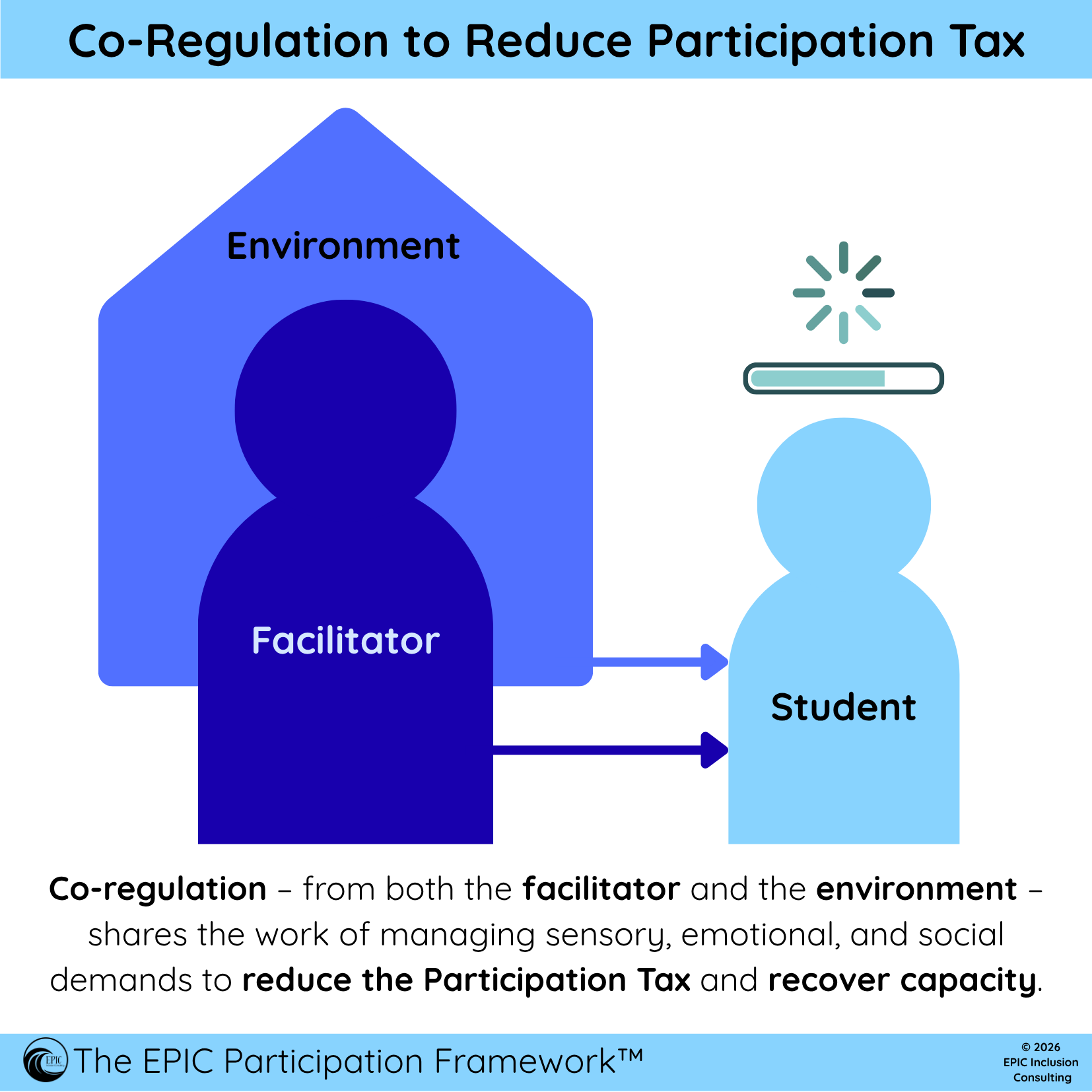
Co-Regulation from the Facilitator and the Environment
When we co-regulate, we don't tell a child to calm down, or expect them to manage on their own. And it isn’t a one-off thing. Sustainable participation tends to follow a loop of engaging, stepping back, regulating and returning (Stimpunks Foundation, 2026), and co-regulation supports every part of it. In my experience, it helps all children, not just those who are neurodivergent or clearly struggling.
Every child and adult is different, with specific co-regulation strategies that work best for them. The strategies below are a starting point to build on by working with parents and carers, who know their child’s needs and signals better than anyone.
Scenario 1: Early signs of stress (becoming Overwhelmed)
It might look like: Fidgeting, hunching or tensing up, going quiet, or withdrawing.
This is probably the most important moment in the co-regulation process. The child is still near the Engaged state, but the Regulation Wave is rising. Your actions and responses can prevent a crash before it happens.
Environmentally: the environment can do a lot of the early co-regulation work.
A visual schedule showing what comes next reduces uncertainty
A calm space the child already knows about and feels safe in
Consistent, warm greeting routines that signal safety from the start
Low background noise and manageable lighting as a baseline
Seating options already available so there’s no negotiation in the moment
From you:
Lower your voice and slow your movements
Offer a choice - “Would you like to sit at the table or on the floor?”
Suggest a break before it’s needed - “Let’s get a drink of water together”
Reduce demands - “You don’t have to finish this right now”
Don’t match their rising energy - your calm is the co-regulation
What to say:
“I can see you’re feeling a bit unsettled. Let’s take a breath together.”
“Would you like to keep going or have a quick break?”
“Let’s have a stretch before we move on.”
What not to do: tell them to calm down, increase pressure, or ignore the signs and wait for them to pass.
Scenario 2: Overwhelmed - meltdown, shutdown, panic
It might look like: Crying, yelling, throwing things or running off - or the opposite: going silent, still and unresponsive.
They can’t learn, listen, or reason right now. Their nervous system has tipped over.
Environmentally: when the environment is already set up for this, you don’t have to improvise under pressure.
A designated calm space with dimmer light, less noise, and less visual clutter
A clear, consistent location the child already knows - so getting there doesn’t require decisions
An exit path that doesn’t require moving through crowds or high-stimulus areas
Minimal adult traffic through the calm space once a child is in it
From you:
Stop talking - your words are extra noise right now
Stay nearby, calm, and quiet
Guide them gently toward the lower-sensory space if you can
Keep your body language open and non-threatening
Be present without demanding anything
What to say:
Very little. If you speak at all, keep it minimal.
“I’m here.”
“Take your time. I’m not going anywhere.”
No questions. No demands. No explanations.
What not to do: talk more, demand explanations, give consequences, or expect compliance.
Scenario 3: Underwhelmed - bored, zoning out, restless
It might look like: Staring into space, slumped shoulders, tapping or tipping back on the chair, doodling, or wandering off.
Their nervous system is asking for more input. This state is easy to miss - especially in community programs where there’s a lot of waiting around.
Environmentally: when the right things are already in place, a child can meet their own needs without it becoming noticeable.
Fidget tools available to everyone, not handed out as a special accommodation
Varied seating options - floor, cushion, standing, wobble stool
Movement-friendly spaces where gentle movement isn’t disruptive
Visual cues for what a child can do when they finish early or need a change
Access to preferred materials or activities that naturally boost engagement
From you:
Add gentle movement - a stretch, a short walk, a fidget tool
Change the task or offer a different role
Use a preferred interest to re-engage them
Check in quietly - sometimes underwhelm is a signal that connection is what’s needed
Check whether unclear expectations or a hidden barrier are making it hard to get started
What to say:
“Let’s stand up and stretch for a minute.”
“Would you like to try a different role in this part?”
“I wonder if a fidget tool would help while you listen.”
What not to do: demand they focus, tell them off for not paying attention, or wait for them to ‘snap out of it’.
When you’re feeling dysregulated too
You’re human. You get stressed, tired, and overwhelmed - and when you’re struggling to regulate yourself, it’s much harder to offer the calm, steady presence a distressed child needs. Your regulation state is part of this story. A few quick strategies to help self-regulate before you co-regulate:
Take one breath before you respond - even a single slow breath can help
Lower your voice intentionally - a calm, slow voice helps both you and the child
Name it to yourself - “I’m feeling stretched right now. I can still be present.”
Step away briefly if your setting allows - a sip of water, a moment outside, whatever’s possible
Remember: you don’t need to be perfect. You need to be present - and willing to repair when things don’t go as planned.
For parents reading this
You’ve been co-regulating with your child for years, by rocking, soothing, and holding them. Trust those instincts. When your child is overwhelmed, your calm presence matters more than any strategy.
You’re also the expert on how co-regulation works for your child specifically. What are their early signs? What helps them settle? What tends to push the wave? Sharing that with their teacher or program leader helps everyone work together in a way that’s consistent and actually fits your child.
About the EPIC Participation Framework
Co-regulation is one of the concepts at the heart of the EPIC Participation Framework, which I’m putting the finishing touches on. If you’d like to be among the first to know when educator and program leader training becomes available, follow me for updates - and if you’d like support in your setting in the meantime, I’d love to hear from you.
One last thought
Co-regulation isn’t about fixing children. It’s about being with them - and designing environments that share the work before a crisis ever arrives. When neurodivergent children experience consistent co-regulation, they learn that they don’t have to manage big feelings alone. And that lesson can last a lifetime.
References
Kolacz, J., & Porges, S. W. (2024). Social co-regulation of the autonomic nervous system between infants and their caregivers. In WAIMH Handbook of Infant and Early Childhood Mental Health (Vol. 1, pp. 169–183). Springer. Retrieved from https://link.springer.com/chapter/10.1007/978-3-031-48627-2_11
Stimpunks Foundation. (2026). Participation Without Presence. Retrieved from https://stimpunks.org/design/participation-without-presence/#a-different-model-of-participation
Perry, B.D. (2019). The Neurosequential Model: A developmentally-sensitive, neuroscience-informed approach to clinical problem solving. In (Janise Mitchell, Joe Tucci & Ed Tronick, Eds), The Handbook of Therapeutic Care for Children: Evidence-Informed Approaches to Working with Traumatized Children and Adolescents in Foster, Kinship and Adoptive Care (pp-137-158). Jessica Kingsley Publishers, London.
Pavlopoulou, G., Chandler, S., Lukito, S. et al. (2025). Situating emotion regulation in autism and ADHD through neurodivergent adolescents’ perspectives. Scientific Reports, 15, 37464. Retrieved from https://www.nature.com/articles/s41598-025-21208-x
Visit these pages for more information:
How-To Series:
Blog Post: A Practical Guide to Protecting the Engaged State in Neurodivergent Children
Blog Post: How to Build Returnability in Your Classroom or Community Program: A Practical Guide
Blog Post: What Neurodivergent Behaviour Is Really Telling You: A Practical Guide to the Regulation Wave
Blog Post: The Rules No One Taught: How to Spot Hidden Expectations in Your Classroom or Program
EPIC Framework Concept Series
Blog Post: Just Being in the Room Isn't Enough - Participation Without Belonging
Blog Post: Returnability: The Measure of Inclusion That Actually Matters
Blog Post: The Regulation Wave: A Reasonable Neurodivergent Crash Out
Blog Post: Hidden Expectations & Hidden Barriers: The Rules No One Tells You & The Challenges No One Sees.
Blog Post: The Participation Pathway: Why Some Children Check Out Before Participation Begins
Blog Post: That Hidden Cost of Joining In (And Why Some Kids Pay More)
EPIC Website Info